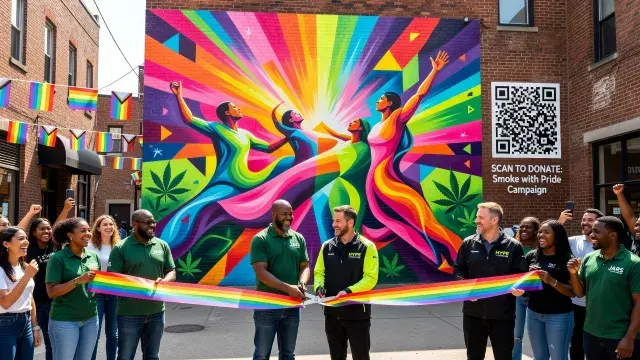
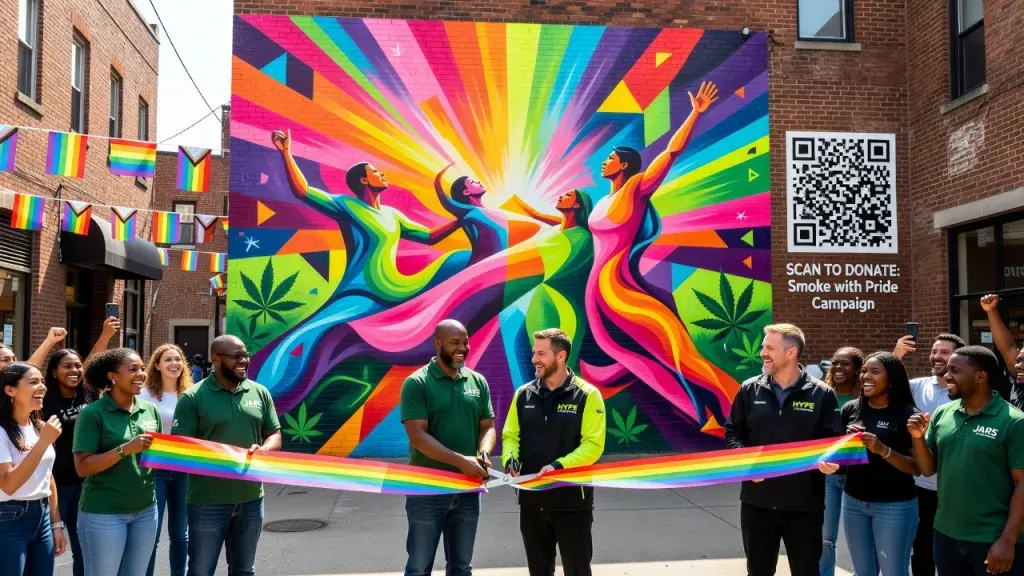
Two Michigan cannabis retailers put their marketing budget behind a public art project this week, and the arrangement says as much about how dispensary brands build community goodwill as it does about the artwork itself. JARS Cannabis and HYPE Cannabis held a ribbon-cutting in downtown Ferndale to unveil "Polychromatic Super You," a 40-by-25-foot mural by Michigan artist Joey Salamon, installed in the alley at 258 W. Nine Mile Rd. The piece anchors the companies' joint Smoke with Pride campaign, which channels proceeds toward Detroit's Ruth Ellis Center, a support organization for at-risk LGBTQ+ youth.
The commercial mechanics behind the mural matter here. Ten percent of proceeds from HYPE products sold at JARS locations, plus 100 percent of proceeds from a dedicated JARS x HYPE Smoke with Pride Kit, go to the nonprofit. That kind of cause-marketing arrangement requires clean accounting on the back end - a retailer has to isolate specific SKUs, track them through point-of-sale systems, and reconcile donation totals against actual sales data before a dollar figure means anything. For multi-state operators or single-location shops alike, that's not a small lift; it means POS configuration, reporting discipline, and a paper trail that can withstand scrutiny if a state regulator or an auditor ever asks how "10 percent of proceeds" was calculated. Retailers evaluating similar cause campaigns often lean on established retail infrastructure - platforms built for dispensary management point of sale vermont operators and others handle exactly this kind of SKU-level tracking - to keep charitable claims defensible rather than aspirational.
A QR code affixed to the mural links visitors to campaign information and a direct donation portal for the Ruth Ellis Center. That's a fairly standard move in retail marketing now, folding a physical installation into a digital funnel, but it also puts a public-facing nonprofit ask on cannabis-adjacent property in a state where advertising rules around cannabis businesses remain closely watched. Michigan's regulations govern how licensed retailers promote themselves, and pairing a storefront-adjacent mural with a scannable donation link sits in a gray zone that brand and compliance teams at other operators should watch - public art funded by a licensed cannabis company is still, functionally, brand marketing, even when the stated purpose is philanthropic.
Why Cannabis Brands Are Turning to Cause Marketing
Cannabis retailers operate under tighter advertising restrictions than most consumer businesses - no broadcast ads in many markets, limits on where signage can appear, and ongoing scrutiny of anything that might read as youth-targeted messaging. Community-facing projects like murals or nonprofit partnerships offer a lower-risk way to build brand visibility without tripping those wires. JARS Marketing Director Stefanie Michels framed the project as an effort to connect cannabis culture's history with LGBTQ+ advocacy, and that kind of narrative works precisely because it sidesteps product promotion altogether - there's no packaging, no potency claim, no purchase incentive baked into the artwork itself.
What Operators Should Take From This
For dispensary owners and operators watching from other states, the lesson isn't really about the mural. It's about structuring a charitable tie-in so the numbers hold up, the marketing stays within advertising rules, and the community benefit is verifiable rather than just implied. Vague "a portion of proceeds" language invites questions; specific percentages tied to specific SKUs, reported transparently, hold up better under both public and regulatory scrutiny.