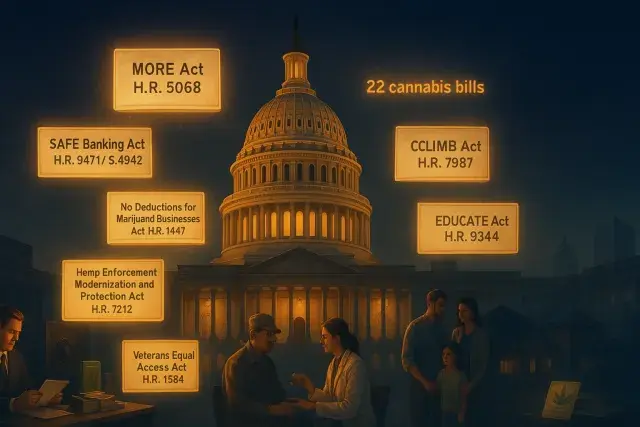
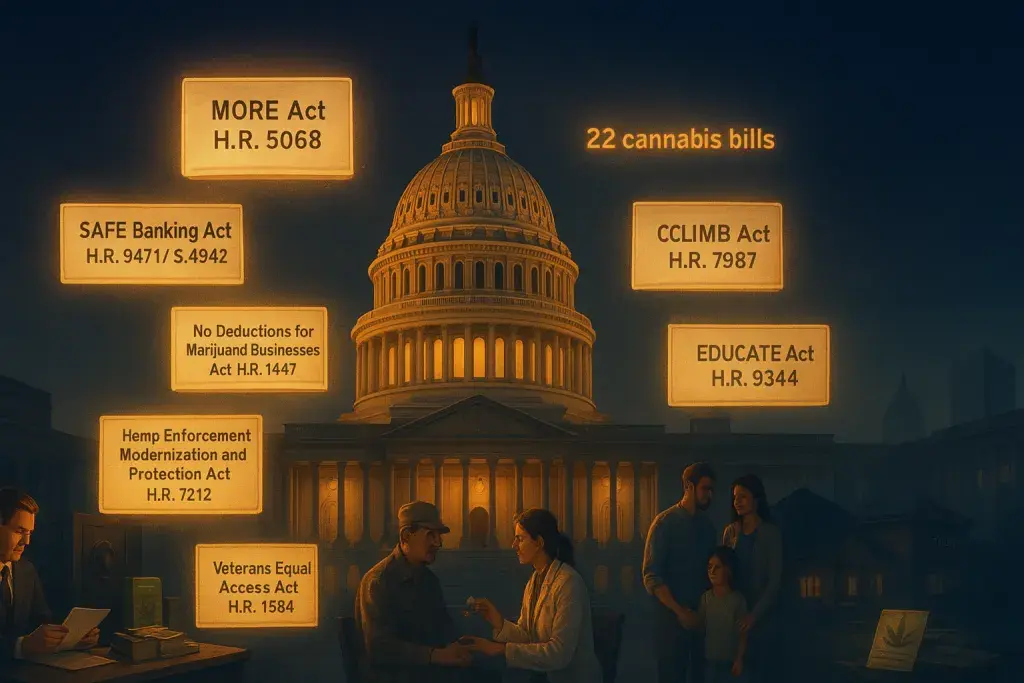
The 2025-2026 congressional session has produced 22 cannabis-related bills and resolutions - and that count doesn't include cannabis amendments attached to broader legislation. The proposals span federal descheduling, banking access, hemp regulation, veterans protections, housing policy, university research, and agricultural education. Taken together, they represent the broadest concentration of cannabis-focused legislative activity at the federal level in recent memory, even if most of these bills face long odds on the floor.
For dispensary operators, compliance officers, payment providers, and cannabis business investors, this isn't abstract politics. Federal law shapes the operational realities that state-licensed businesses deal with every day - from 280E tax exposure and banking access to the housing status of their employees and customers. Operators in markets where state frameworks are still maturing, who want to learn more about how federal developments intersect with local licensing conditions, should be tracking this session carefully. What passes, what stalls, and what gets folded into a broader bill all have downstream consequences for capital access, tax liability, and compliance posture.
The MORE Act (H.R. 5068), with 74 sponsors - the most of any cannabis bill filed this session - would remove marijuana from the federal Controlled Substances Act entirely, expunge qualifying convictions, and establish reinvestment programs for communities most affected by prohibition enforcement. It's the most sweeping proposal on the list. But broad sponsor counts in the House don't guarantee floor votes, and the MORE Act has a long history of stalling. Still, 74 co-sponsors signal that political appetite for descheduling or descheduling-adjacent policy has not retreated.
Banking, Capital, and the 280E Problem Remain Front and Center
The SAFE Banking Act of 2026 (H.R. 9471 / S. 4942) is back. Again. The bill would shield banks and credit unions from federal penalties for serving state-licensed cannabis businesses. That protection sounds straightforward - and it is - but the absence of it has forced most cannabis retailers to operate with significant cash exposure, limited merchant processing options, and workaround payment systems that carry their own compliance risks. Every year SAFE Banking doesn't pass, operators absorb higher cash-handling costs, security risks, and banking fees from the few financial institutions willing to take the business.
The CLIMB Act (H.R. 7987) goes further. It would allow state-legal cannabis companies to access national securities exchanges and broader financial services. Right now, multi-state operators and single-location dispensaries alike are largely shut out of conventional capital markets because of federal prohibition. That affects everything from growth financing and real estate acquisition to vendor payment terms and insurance underwriting. The CLIMB Act has six House sponsors - a thin coalition - but it addresses a real structural gap that equity investors and cannabis business lenders have been working around for years.
Then there's the No Deductions for Marijuana Businesses Act (H.R. 1447 / S. 471), which goes in the opposite direction. This legislation would permanently block marijuana businesses from claiming standard federal tax deductions - even if marijuana is rescheduled. That's a direct counter to the assumption held by many operators that rescheduling under Schedule III would finally relieve them of 280E's punishing effect. If this bill gained traction, rescheduling would deliver far less financial relief than the industry expects. Worth noting: the House version already has 12 sponsors. Operators and their tax counsel should not treat Schedule III as a guaranteed 280E off-ramp.
Hemp Regulation Is in Active Flux - and Time Is a Factor
Three hemp-related delay bills - H.R. 7010, H.R. 7024, and S. 3686 - were filed in rapid succession in January 2026. All three aim to pause implementation of federal restrictions on hemp-derived products, giving Congress more runway to craft a coherent regulatory framework. The House versions carry 42 combined sponsors, the Senate version three. That disparity reflects where hemp lobbying pressure is concentrated right now.
The Hemp Enforcement Modernization and Protection Act (H.R. 7212) and the Hemp Safety Enforcement Act (S. 4315) both attempt to define what that framework should look like: age restrictions, product testing, labeling requirements, and - in the Senate version - a path for FDA regulation of hemp-derived cannabinoids as dietary supplements and food ingredients. The Cannabinoid Safety and Regulation Act (S. 3474) covers similar ground with an added focus on impaired-driving prevention. For retailers stocking hemp-derived products alongside licensed cannabis, the regulatory uncertainty here creates real inventory and compliance exposure. Which products will require what documentation, testing standards, or age-gating depends on which - if any - of these bills moves.
Veterans, Housing, and Research Bills Round Out the Legislative Picture
Two veterans-focused bills address overlapping but distinct concerns. The Veterans Equal Access Act (H.R. 1384) would allow VA physicians to recommend medical marijuana in states where it's legal. The Veterans Cannabis Use for Safe Healing Act (H.R. 966) would prevent the VA from denying benefits to veterans enrolled in state-approved medical marijuana programs. Both have modest sponsor counts, but they respond to a documented policy gap: veterans in legal states are often unable to discuss marijuana use with federal healthcare providers without risk to their benefits.
The Marijuana in Federally Assisted Housing Parity Act (H.R. 6807 / S. 3537) addresses a similarly concrete problem - state-compliant marijuana users being denied or evicted from federally assisted housing. For cannabis retail workers, social equity licensees, and lower-income consumers in legal markets, this is not a peripheral issue. It's a condition of daily life.
On the research side, both the Higher Education Marijuana Research Act (H.R. 8394) and the EDUCATE Act of 2026 (H.R. 9344) would fund cannabis agriculture research and education at colleges and universities, with the EDUCATE Act specifically targeting institutions serving Black, Hispanic, and other underrepresented students. The PREPARE Act (H.R. 2935 / S. 3576), meanwhile, would establish a federal commission to develop regulatory recommendations in the event prohibition ends - essentially pre-building the architecture for a post-prohibition federal framework. That's a pragmatic acknowledgment that full legalization, if it comes, will require more regulatory infrastructure than Congress has prepared.
Twenty-two bills. Most won't pass as standalone legislation. Some will be folded into omnibus packages or stripped down to amendments. A few may not receive a committee hearing. But the legislative record matters regardless - it reflects where political pressure is accumulating, which operational pain points have enough constituency to reach the floor, and what federal cannabis policy could look like in the next two to five years. Operators who dismiss this session as noise are likely underestimating how fast the federal ground can shift when the right political conditions align.