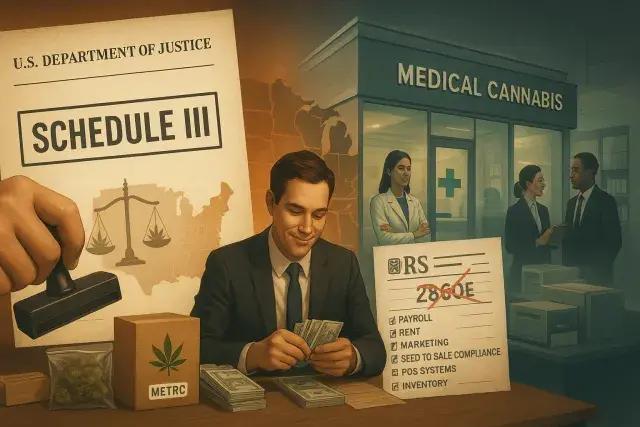
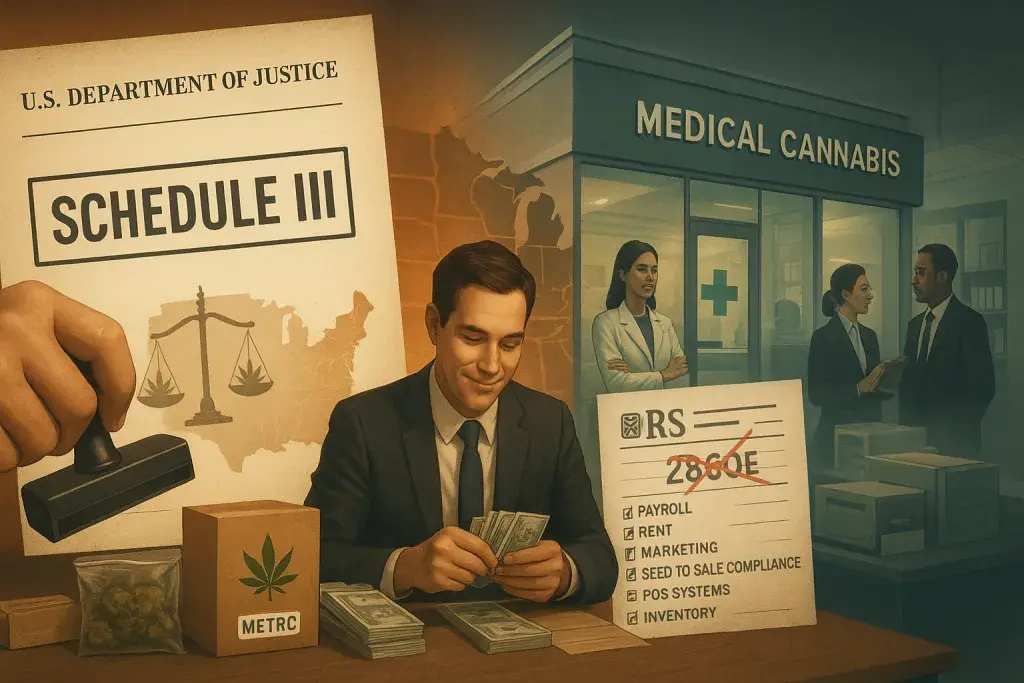
The U.S. Department of Justice's move to downgrade cannabis from Schedule I to Schedule III under the Controlled Substances Act represents the most significant federal policy shift for the cannabis industry in decades. For medical marijuana businesses, the immediate upside is concrete: rescheduling opens the door to federal tax relief that has long been denied under Section 280E of the Internal Revenue Code, and it clears a path for expanded cannabis research at state universities. But here's the catch - the federal-state divide that has defined cannabis regulation since California first legalized medical use in 1996 remains fundamentally intact.
Section 280E has been one of the most punishing financial realities for licensed cannabis operators. Because cannabis was classified as a Schedule I substance, businesses selling it were prohibited from deducting ordinary business expenses - payroll, rent, marketing, compliance costs - that any other retailer takes for granted. The result has been effective tax rates that can dwarf those of comparable businesses in conventional retail. Rescheduling to Schedule III would remove cannabis from 280E's reach, at least for medical cannabis operations, allowing operators to deduct standard business expenses and dramatically reduce their federal tax burden. For a multi-location medical dispensary carrying significant overhead - staff, POS systems, seed-to-sale compliance infrastructure, compliant packaging, and wholesale inventory - that shift in deductible expenses could meaningfully change the bottom line. Operators in markets with dense compliance requirements, including those researching best cannabis pos systems colorado to manage the regulatory complexity, understand that reducing the tax drag on operations isn't an abstract benefit - it directly affects staffing capacity and capital availability.
The research angle matters too, and probably doesn't get enough attention. Rescheduling opens federal funding channels for cannabis studies at state universities, which have largely been locked out of meaningful clinical and agricultural research because of the drug's Schedule I status. More research doesn't immediately change dispensary operations - but over time, a stronger evidence base affects product safety conversations, labeling standards, and the regulatory arguments states make when setting compliance frameworks. For B2B operators in the supply chain, including testing labs, cultivators, and manufacturers producing Certificates of Analysis for wholesale buyers, a better-funded research environment eventually supports more rigorous and consistent testing standards across state lines.
What Rescheduling Does Not Fix
To put it plainly: rescheduling is not legalization. Adult-use cannabis operations - the retail dispensaries selling to consumers without a medical card - remain in a complicated position. The 280E tax relief under rescheduling may apply most cleanly to businesses operating exclusively in the medical cannabis space. Operators running dual-use or adult-use storefronts will need to work closely with tax counsel to understand how their specific license structure, product mix, and revenue allocation interacts with the new classification. That is not a small administrative task.
Beyond taxation, the core architecture of cannabis compliance stays state-driven. Seed-to-sale tracking through systems like METRC, state-level license caps, local zoning restrictions, excise tax structures, and packaging and labeling rules all remain products of individual state regulatory bodies. The DOJ rescheduling doesn't harmonize any of that. A dispensary operator running stores in multiple states still faces a different compliance stack in each jurisdiction - different track-and-trace requirements, different potency testing thresholds, different rules around delivery manifests and cashless payment acceptance. Rescheduling doesn't create a federal retail standard. It adjusts a tax and scheduling classification. Those are meaningful things, but they are not the same thing.
Operational and Strategic Implications for Licensed Businesses
For multi-state operators and single-location dispensaries alike, the near-term priority is getting ahead of the tax question. That means working with accountants who understand cannabis-specific taxation - not general small-business tax advisors who are unfamiliar with how 280E has historically applied, or with how cost-of-goods calculations have been used as the primary deduction vehicle available to cannabis businesses. The rescheduling doesn't take effect automatically or uniformly; the regulatory process involves additional steps, and the timeline for when relief formally kicks in requires careful tracking.
Investors and operators evaluating new market entries or license acquisitions will also need to recalibrate their financial models. If 280E exposure drops significantly for medical operations, the valuation math on medical-license-only businesses changes - potentially improving capital access for companies that have historically looked unprofitable on paper largely because of the tax treatment. That's not a trivial shift for the investment side of the cannabis B2B market.
What remains true across all of this is that the federal-state misalignment isn't a problem rescheduling was designed to solve. States built their entire regulatory infrastructure - from social equity licensing programs to lab testing mandates to retail compliance requirements - in the absence of federal coordination. That infrastructure doesn't disappear or simplify because of a scheduling change. Licensed operators, compliance officers, and the technology vendors who serve them are still working in a patchwork system. Rescheduling improves the economics for some. It does not resolve the underlying fragmentation.