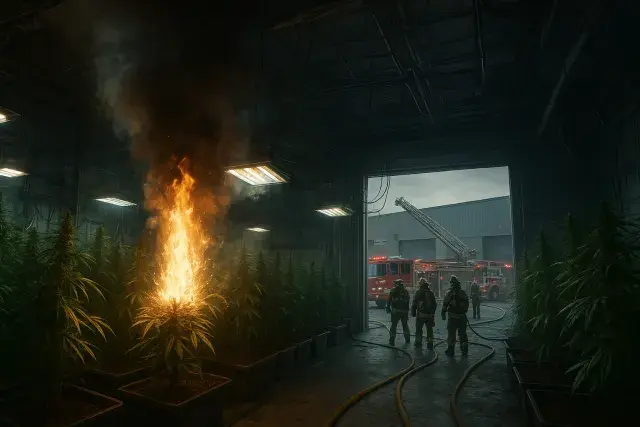
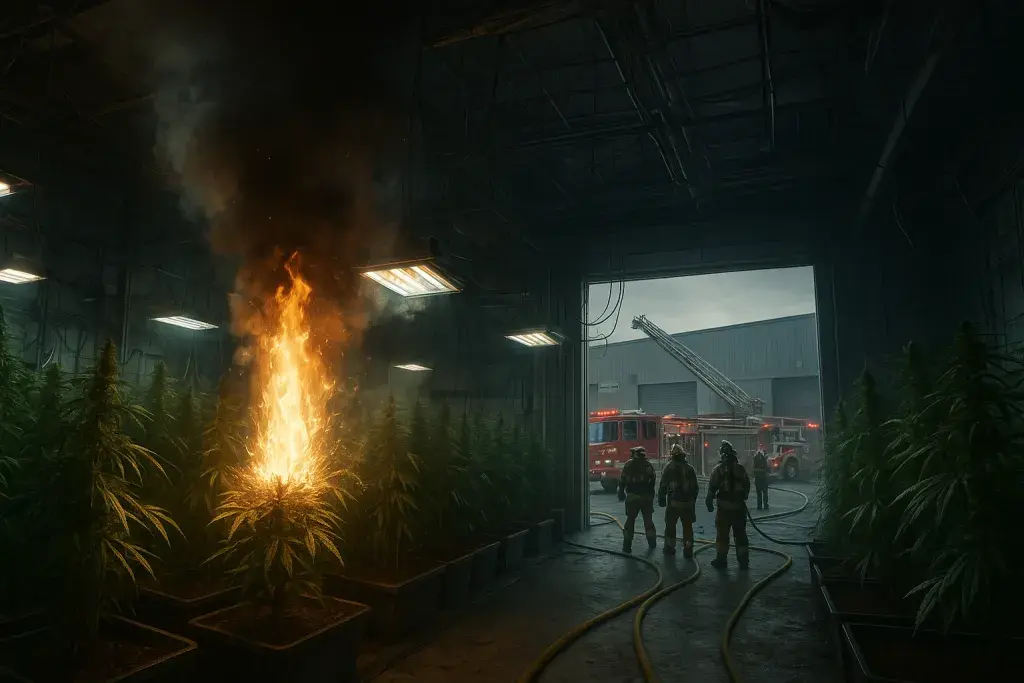
A broken light fixture ignited a fire Tuesday inside a permitted cannabis grow room at a warehouse complex on Giffen Avenue in Santa Rosa, California, causing an estimated $180,000 in damage to the building and its contents, fire officials confirmed July 8. The blaze was contained within roughly 20 minutes, and no injuries were reported - but the incident puts a sharp spotlight on a risk that licensed cannabis cultivators and their landlords often underestimate: the fire hazard profile of high-intensity commercial grow operations.
Twenty-three personnel responded, including three fire engines, a ladder truck, a heavy rescue unit, a squad, two battalion chiefs, and a fire investigator - a resource deployment that reflects how seriously fire authorities treat cannabis facility incidents. Division Chief Fire Marshal Paul Lowenthal confirmed that smoke damage accounted for the bulk of the $180,000 loss estimate, and that the facility was not red- or yellow-tagged following the incident, meaning operations were not restricted. For operators managing licensed cultivation under California's strict regulatory framework - or exploring what compliant operations look like in other regulated markets, where you can learn more about state-specific requirements - this kind of outcome, no injuries and no license jeopardy, represents the best-case version of a bad situation.
Why Cannabis Grow Rooms Carry Elevated Fire Risk
Here's the operational reality: commercial cannabis cultivation environments are, by design, energy-intensive. High-intensity discharge lamps, LEDs running extended photoperiods, ballasts, transformers, and dense electrical infrastructure packed into warehouse grow rooms create conditions that standard commercial occupancy fire codes were not originally written with in mind. Add to that the fact that many cannabis operations - particularly those sharing warehouse complexes with other licensed tenants, as appears to be the case on Giffen Avenue - are occupying buildings that may have been retrofitted for cultivation rather than purpose-built.
A broken fixture sounds like a minor maintenance failure. In a grow room, it isn't. The combination of heat-generating lighting systems, dry plant material, combustible growing media, and concentrated electrical loads means that a single point of failure can escalate quickly. The fact that firefighters contained this fire in approximately 20 minutes - and that the facility avoided tagging - suggests both an adequate suppression response and a grow room configuration that did not catastrophically accelerate the fire. That's not always the outcome.
What Operators and Landlords Should Take From This
For licensed cannabis cultivators, this incident is a concrete reminder that preventive infrastructure maintenance is not optional - it's compliance-adjacent. California's Bureau of Cannabis Control and the California Department of Food and Agriculture, which oversees cultivation licenses, require permitted facilities to maintain conditions consistent with their approved premises applications. A fire resulting from deferred maintenance on grow lighting doesn't just create an insurance claim; it can generate scrutiny from state licensing authorities and local fire marshals with jurisdiction over the permitted premises.
Landlords leasing warehouse space to cannabis tenants face their own exposure. Multi-tenant cannabis warehouse complexes - like the one on Giffen Avenue, which reportedly houses multiple growing operations - carry shared infrastructure risk. A fire in one grow room can produce smoke damage that migrates across adjacent tenant spaces, as appears to have happened here. Lease agreements, tenant improvement build-outs, and insurance underwriting for cannabis occupancies need to account for this explicitly. Cannabis-specific property insurance is a specialized market, and standard commercial property policies frequently exclude or limit coverage for licensed cannabis operations.
The Compliance and Operational Implications
The fact that the Santa Rosa facility avoided red- or yellow-tagging is operationally significant. A red tag - essentially a prohibition on use - would have halted cultivation activities, potentially triggering compliance consequences under seed-to-sale tracking requirements. Any plants in process, any active grow cycles, any pending harvest would be affected. For a commercial cultivation operation, even a brief forced shutdown translates directly into lost wholesale revenue, disrupted supply commitments to downstream dispensary customers, and potential inventory compliance complications under METRC reporting obligations.
The broader takeaway for operators is straightforward: lighting system maintenance schedules, electrical inspection intervals, and fire suppression system testing are not back-office afterthoughts. They are front-line risk management tools in facilities where a single equipment failure can produce six-figure losses in under an hour. In a business where margins are already compressed by excise taxes, high cost of goods, and the ongoing burden of operating in a cash-heavy or limited-banking environment, an uninsured or underinsured fire loss can be existential. The Santa Rosa incident, contained and without injury, is - in the plainest terms - a warning worth heeding.