The U.S. Department of Justice's April 23 announcement placing certain FDA-approved marijuana products and state-licensed medical cannabis into Schedule III of the Controlled Substances Act is real. So is the temptation to overstate what it means. Insurance and cannabis industry sources are largely aligned on a more measured read: this is a meaningful step forward for a portion of the market - particularly medical operators - but it stops well short of the structural overhaul that would materially reshape cannabis business economics or insurance availability across the board.
What the Rescheduling Actually Covers - and What It Doesn't
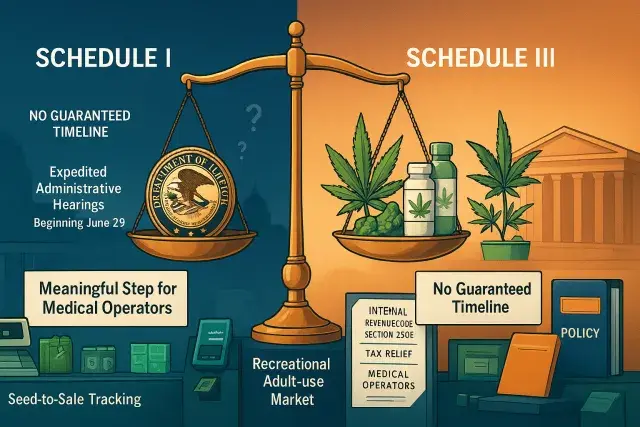
The April action is narrower than the headlines suggested. It applies specifically to FDA-approved marijuana products and to products subject to a qualifying state-issued medical license. State-licensed recreational cannabis - the larger and faster-growing commercial segment in most adult-use markets - remains Schedule I and federally illegal. That's not a footnote. It's the part of the market where the majority of dispensary volume, wholesale activity, and multi-state operator revenue actually lives.
The DOJ also announced it would begin an expedited administrative hearing process on June 29 to consider broader rescheduling of marijuana from Schedule I to Schedule III. That process is separate from the April action and carries no guaranteed outcome or timeline. For operators building financial models or insurance strategies around rescheduling, that distinction matters.
Moving marijuana from Schedule I - a category that includes heroin - to Schedule III, which covers substances with accepted medical uses and lower abuse potential, would be a genuine shift in how federal law treats the drug. But the mechanism is administrative, the scope is contested, and the downstream regulatory questions - how the FDA, DEA, and Department of Health and Human Services each engage with a newly categorized substance - remain largely unanswered.
The 280E Question Is Where Operators Are Actually Watching
Here's where the rescheduling has real, near-term business implications. Section 280E of the Internal Revenue Code prohibits businesses trafficking in Schedule I or II controlled substances from deducting ordinary business expenses from federal taxable income. Cannabis operators have been living under that restriction for years, carrying effective tax rates that can reach multiples of what a comparable non-cannabis retailer pays. That tax burden compresses margins, limits reinvestment, and complicates cash flow management across the entire operational stack - from payroll and rent to POS systems and compliance staffing.
If medical cannabis operators gain relief from 280E through rescheduling to Schedule III, the profitability improvement could be material. Operators who had been writing off next to nothing on the expense side would suddenly have access to standard business deductions. That changes balance sheets. It changes cash available for capital expenditure, inventory investment, and risk management infrastructure. It also changes the conversation with lenders and, potentially, with underwriters.
The catch - and there is one - is that the April action's scope is still being interpreted. Operators with mixed medical and adult-use operations may need to separate those business units more cleanly to capture the benefit. The accounting and compliance complexity of doing that cleanly, across licensing structures, POS tracking, and seed-to-sale reporting systems, is not trivial. As one operator put it: more questions than answers right now.
Why the Insurance Market Isn't Moving Yet
For cannabis insurance, the rescheduling is being treated as a directional positive - not a trigger event. Policy language doesn't update because a scheduling announcement was made. Admitted market access doesn't open overnight. Underwriting guidelines reflect regulatory certainty, operator financial stability, and demonstrable risk management practices - none of which changed on April 23.
What the rescheduling may do, over time, is begin removing some of the structural barriers that have historically pushed cannabis operators into surplus lines markets with limited coverage options and restrictive exclusions. If improved margins from 280E relief translate into stronger operator balance sheets, that matters to underwriters. Better-capitalized operators tend to invest more in safety protocols, compliance infrastructure, and loss prevention - the kinds of operational signals that make a commercial account more attractive to carriers and MGAs.
But "may" is doing a lot of work in that sentence. The rescheduling order, by multiple accounts from insurance professionals in the sector, is incomplete. The administrative hearing process adds another layer of uncertainty. Until the regulatory picture firms up and the downstream agency questions get resolved, underwriting discipline isn't going anywhere, and operators shouldn't expect their renewal conversations to look dramatically different.
What Operators Should Actually Be Doing Right Now
For licensed medical cannabis operators, the priority is straightforward: engage legal counsel and tax advisors now to assess 280E exposure and model the actual financial impact of potential relief under Schedule III. Don't assume the benefit is automatic or universal - the specifics of how state licenses interact with the federal rescheduling framework are still being worked out.
Operators with both medical and recreational licenses face a more complex structural question. Separating those operations clearly enough to capture available tax benefits, while maintaining compliant seed-to-sale tracking and accurate reporting across business units, requires both legal clarity and operational precision. Point-of-sale systems, inventory management platforms, and compliance logs will all need to reflect any structural separation accurately.
On the insurance side, the near-term move is to document operational improvements and financial stability wherever possible - because that's the conversation that actually influences coverage terms. Stronger financials, cleaner compliance records, and lower claims histories are the levers available right now. The rescheduling may eventually open doors in the admitted market, but that's a medium-term development, not an April outcome.
The broader picture here is one the industry has lived through before: a genuine policy development, real but bounded implications, and a long tail of regulatory detail that will determine what any of it actually means in practice. That's not pessimism. It's how regulated industries move.