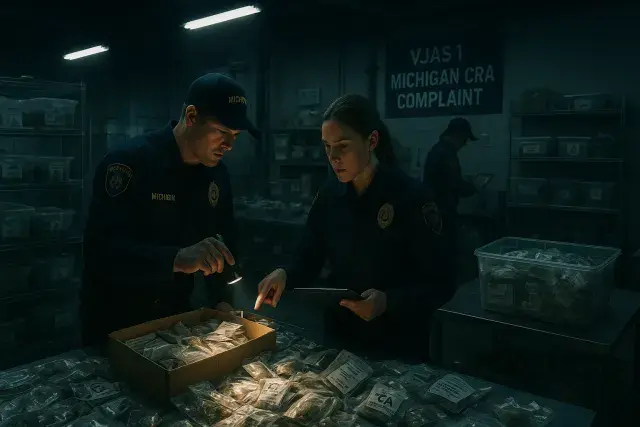
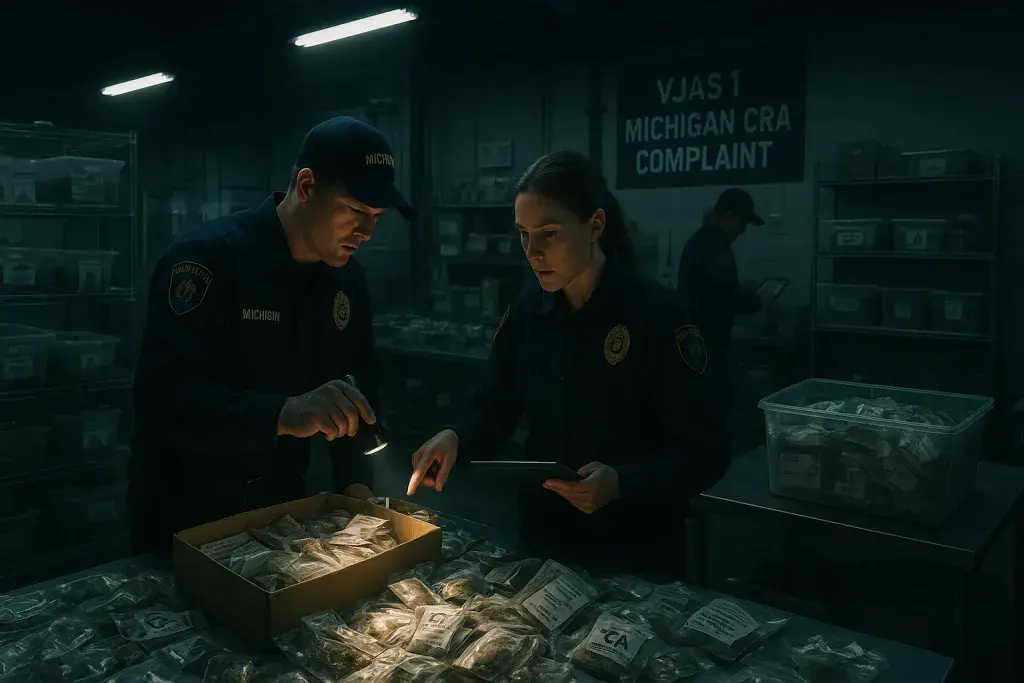
Michigan's Cannabis Regulatory Agency has filed a formal complaint against VJAS 1, a licensed cannabis processor operating in Harrison Township, after an inspection uncovered more than 12,000 individual cannabis products with no Metrc tags or other identifying information on-site. Among those unidentified products were items packaged in California-specific packaging - bearing the abbreviation "CA" and California's required consumer warning language - raising immediate questions about whether products crossed state lines. The CRA is now pursuing fines and potential license suspension, revocation, restriction, or non-renewal.
The compliance failures here are not subtle. Seed-to-sale tracking systems like Metrc exist precisely to prevent this kind of inventory opacity - every product batch that enters or exits a licensed facility is supposed to carry a tag that ties it to a verified chain of custody within the state system. When investigators found Metrc-tagged products at the VJAS 1 facility, that might have looked like partial compliance - except cross-referencing revealed those tagged items were recorded in the system as belonging to other cannabis businesses entirely. That is not a paperwork gap. That is a fundamental breakdown in inventory control, and it is the kind of finding that draws immediate regulatory escalation. Operators in other states tracking this enforcement pattern - whether they use dispensary software arizona or Metrc-integrated platforms elsewhere - should treat it as a reminder that compliant tracking isn't optional infrastructure; it's the foundation every license rests on.
What's striking here is the scale. More than 12,000 untagged units is not a clerical error or a missed scan at intake. That volume suggests either a systematic failure to record incoming inventory or - and regulators will be examining this closely - the deliberate introduction of product sourced outside Michigan's licensed supply chain. Employees at the facility reportedly could not explain how so many untagged products came to be present. That inability to account for inventory is itself a compliance red flag; regulated cannabis businesses are required to maintain records sufficient to trace every unit, and "we don't know" is not a defensible answer during an enforcement inspection.
Why Out-of-State Packaging Changes the Severity of This Case
California packaging is not an incidental detail. Every state that has legalized adult-use cannabis has its own labeling and packaging requirements - specific font sizes, mandated warning language, child-resistant standards, and market-specific identifiers. California's requirements are among the most detailed in the country. Product bearing California's consumer warnings and the "CA" market identifier was not produced for Michigan's licensed market. Its presence in a Michigan processing facility, absent any documentation, points toward gray or illicit supply-chain activity rather than a simple tracking oversight.
Interstate cannabis commerce remains federally prohibited. Even between two states with robust adult-use programs, moving cannabis across state lines constitutes a federal violation - and licensed operators who receive or distribute such product put their entire license in jeopardy. For a processor, the exposure is compounded: processors handle product in bulk, and untagged inventory at that stage of the supply chain can propagate compliance failures downstream to any retailer or dispensary that ultimately receives those goods.
The Operational and Licensing Risk Processors Now Face
VJAS 1 faces a range of potential consequences - fines, restrictions, suspension, revocation, and refusal to renew. In practice, even a suspension can be operationally devastating. Processors depend on consistent throughput; a forced pause disrupts relationships with licensed retailers who rely on that supply, creates financial strain, and can trigger contract defaults with cultivators supplying raw material. Revocation is effectively a business death sentence in a regulated market where licenses are finite and reapplication carries no guarantee of success.
For other operators, this enforcement action is a signal worth paying attention to. Metrc compliance is not merely about avoiding citations - it is the mechanism through which a licensed business proves the legitimacy of its inventory to regulators, wholesale partners, and, ultimately, consumers who expect that the products reaching their hands came through a tested, documented chain. Gaps in that chain are not recoverable with a retroactive explanation. Regulators across multiple adult-use states have made clear that untagged inventory and unexplained product on-site are treated as serious violations, not technical infractions subject to a warning and a cure period.
What Licensed Operators Should Take From This Enforcement Action
The VJAS 1 case illustrates a straightforward risk framework that every licensed processor and retailer should be stress-testing internally. Inventory reconciliation - comparing physical product against Metrc records on a regular basis - is the first line of defense. The moment product counts diverge from system records, the investigation should begin internally, not wait for a CRA inspector to raise the question. Equally important: any incoming product without a verifiable Metrc tag and documented chain of custody should be treated as uncompliant and quarantined until its origin is established or it is surrendered to regulators.
The presence of out-of-state packaging compounds every element of an enforcement case. It shifts the regulatory conversation from inventory management failures to potential illicit supply-chain involvement - a different category of scrutiny, one that invites more aggressive action and a harder path to license preservation. Michigan's CRA has shown it will pursue formal complaints rather than settle for administrative corrections when the evidence points beyond clerical error. That posture is consistent with how regulators in mature adult-use markets have historically responded when the integrity of the licensed supply chain is called into question.