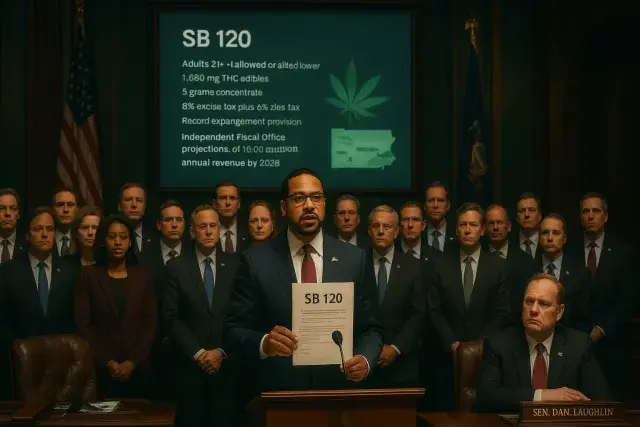
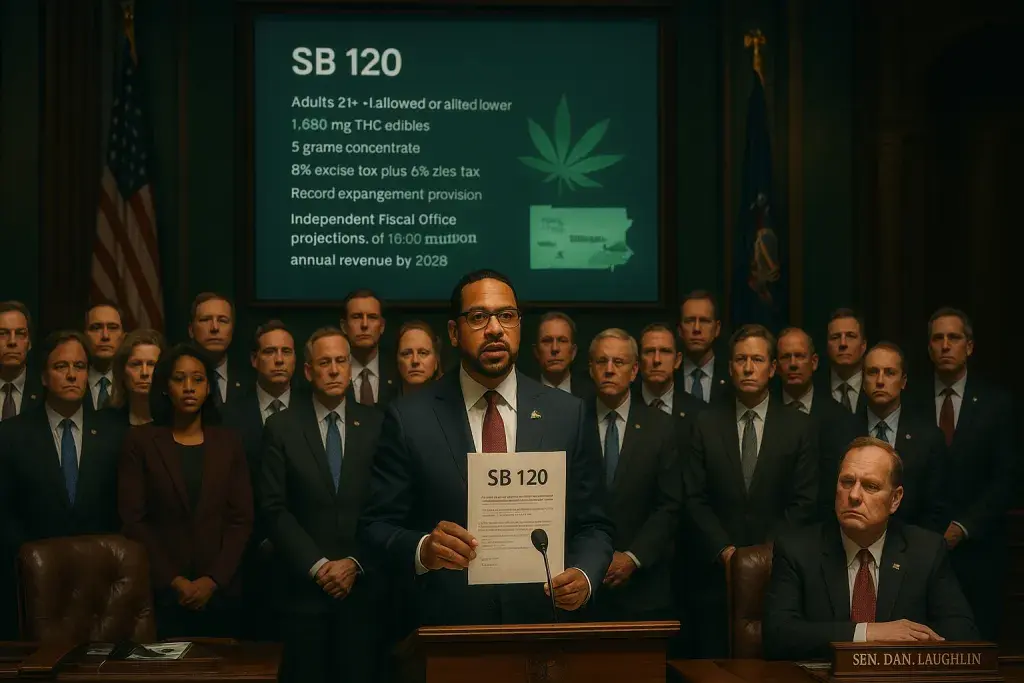
Senate Democrats in Pennsylvania have filed a discharge resolution aimed at pulling a bipartisan adult-use cannabis bill out of committee and onto the floor for a full vote - a procedural maneuver that, while it doesn't guarantee passage, has forced a public reckoning about where exactly the Republican majority stands on legalization. Led by Sen. Sharif Street, all 23 members of the Senate Democratic caucus have signed onto the resolution, putting a formal spotlight on SB 120, a bill Street co-sponsored with Republican Sen. Dan Laughlin. Laughlin, who chairs the Senate Law & Justice Committee, has yet to call the legislation up in his own panel.
What the Bill Would Actually Do - and What's at Stake Commercially
For cannabis operators and prospective licensees watching Pennsylvania closely, the details of SB 120 matter. The bill would permit adults 21 and older to possess up to 30 grams of cannabis flower, 1,000 milligrams of THC in edible products, and 5 grams of concentrate. On the tax side, it would establish an 8 percent excise tax on cannabis sales on top of the state's existing 6 percent sales tax - a combined 14 percent tax burden that would shape wholesale pricing, retail margins, and product mix decisions from day one. Pennsylvania operators in adjacent states already running dispensary pos system New York-style retail environments understand exactly how that tax structure flows through the point-of-sale and into compliance reporting. The bill also includes a record expungement provision for prior marijuana-related convictions, a component with direct relevance to social equity licensing discussions that would inevitably follow any legalization framework. The state's Independent Fiscal Office has projected that a legal adult-use market could generate nearly half a billion dollars in annual revenue by 2028 - a figure that shapes the governor's budget calculus and, more practically, defines the size of the market operators would be entering.
A Procedural Move With Real Political Weight
Discharge resolutions don't compel a committee to act. Street said as much on the floor when introducing the measure. But here's the thing - that's not entirely the point. By forcing every senator to go on record about whether a bipartisan bill with a Republican prime sponsor, a Democratic governor's backing, and polling support from roughly three-quarters of Pennsylvania voters should even receive an up-or-down vote, Democrats are creating a political document. Republicans hold a 27-23 majority, which means the discharge resolution almost certainly won't move forward unless GOP members break ranks. But the resolution puts operational and fiscal pressure on a state that has watched neighboring New Jersey, New York, Maryland, Delaware, and Ohio each open regulated adult-use markets. Street put it plainly: Pennsylvanians are crossing state lines daily to buy legal cannabis and transporting it back across borders illegally, generating tax revenue for neighboring states while Pennsylvania collects nothing and takes on the public safety and enforcement costs.
The Laughlin Bill Collapse Adds Complexity
The discharge resolution doesn't exist in a vacuum. It follows the Senate floor defeat of Laughlin's separate Cannabis Control Board bill, SB 49, which would have transferred regulatory authority over the existing medical marijuana program from the Department of Health to a new seven-member board - covering seed-to-sale tracking, licensing, advertising, labeling, and testing oversight. The bill failed when nearly all Democrats voted against it, reportedly after Gov. Josh Shapiro's office signaled opposition. The governor's spokesperson said the measure didn't "substantively advance" comprehensive cannabis regulation or enable a competitive, revenue-generating adult-use market. The Senate did adopt a motion to reconsider SB 49 almost immediately after its defeat, leaving the question of its future unresolved. For compliance professionals and multi-state operators, the collapse of SB 49 is worth watching: it suggests that Pennsylvania's regulatory architecture - particularly who oversees medical cannabis and how seed-to-sale tracking is administered going forward - remains genuinely unsettled. That kind of regulatory uncertainty has downstream effects on dispensary operations, supplier contracts, and technology procurement decisions throughout the supply chain.
What Operators Should Watch From Here
Pennsylvania represents one of the largest untapped adult-use markets on the East Coast. The political dynamics are messy right now - a Republican committee chair blocking a bill he co-sponsored, a governor opposing the regulatory reform bill that same Republican is advancing, and a prospective GOP gubernatorial candidate who has said outright she'd veto legalization. That sounds like gridlock. In practice, though, the pressure is building structurally. Federal cannabis rescheduling efforts, which the governor's office called "an important step," add weight to the conversation at the state level. A Republican senator has also acknowledged that federal reform makes state legalization easier to advance politically. For dispensary operators, wholesalers, technology vendors, and payment processors building out East Coast footprints, the timeline on Pennsylvania entry may be shorter than the current legislative chaos suggests - or it may drag into another budget cycle. Either way, SB 120's provisions on possession limits, tax rates, and expungement set the commercial and compliance parameters around which the entire regulated retail ecosystem would need to organize. Watching whether GOP leadership allows the discharge resolution to come up for a vote will say something real about where the Pennsylvania Senate is actually headed.