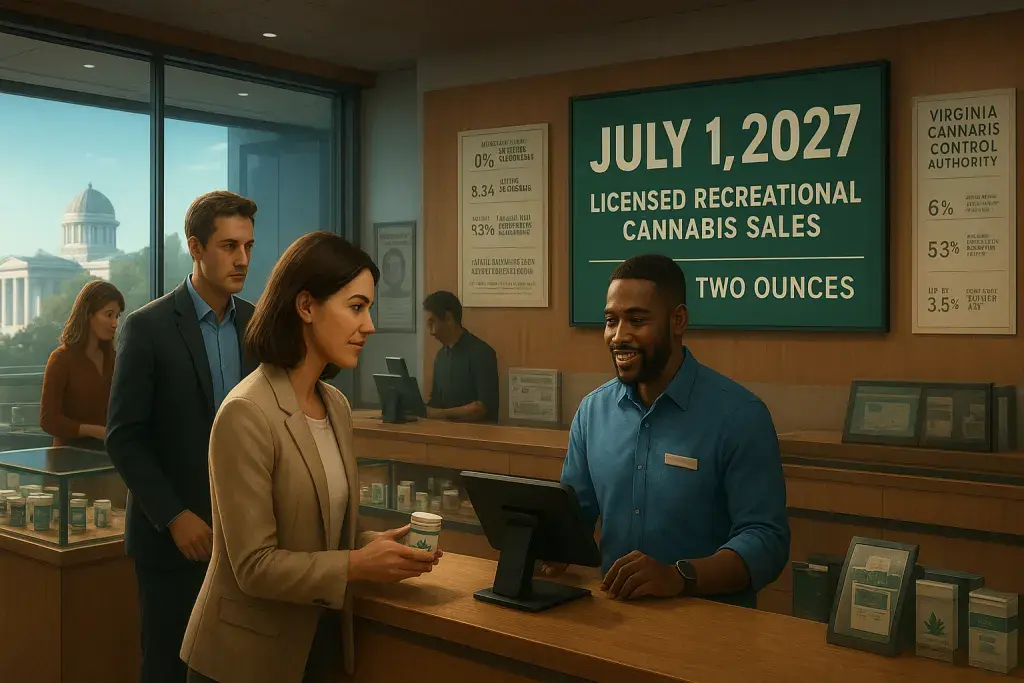
Virginia has finally closed the gap - at least on paper. With the state budget signed into law, Virginia now has a legally binding framework for adult-use cannabis retail, with licensed recreational sales set to begin July 1, 2027. That date ends an awkward six-year stretch in which adults could legally possess marijuana but had no licensed store to buy it from - a structural contradiction that left consumers, operators, and would-be investors in prolonged limbo.
The road here was anything but smooth. Former Gov. Glenn Youngkin vetoed multiple retail-market bills. Gov. Abigail Spanberger issued her own veto earlier this year before ultimately negotiating a compromise that landed the framework inside the state budget itself. For operators tracking adult-use market development across the Mid-Atlantic region - the kind of multi-state analysis covered in resources like https://indicaonline.com/markets/massachusetts/ for comparable regulated markets - Virginia's arc illustrates how quickly a political logjam can break, and how little time the industry gets to prepare once it does.
The Virginia Cannabis Control Authority now holds the regulatory pen. Between now and mid-2027, the agency must write rules, open an application window, evaluate licensees, and establish testing, packaging, and labeling standards before a single compliant transaction can occur. That is not a long runway. Operators who want to be ready at launch need to begin treating this as a pre-license phase - not a waiting period.
What the Market Structure Actually Looks Like
Virginia expects to license up to 350 retail cannabis stores statewide. Purchase limits at launch will be set at two ounces per transaction - a notable increase over the current one-ounce personal possession cap. Adults 21 and older will be able to buy from licensed retailers, and delivery will be permitted once the recreational market opens. Local governments cannot ban cannabis businesses outright, though they retain zoning and land-use authority, which means siting decisions will carry real operational weight.
On taxes: recreational sales will carry a 6% state cannabis excise tax, Virginia's standard 5.3% sales tax, and an optional local tax of up to 3.5%. Beginning in 2029, the state excise tax steps up to 8%. That combined tax burden - potentially reaching nearly 15% at the point of sale before the 2029 increase - sits in a range that operators in other regulated states have found tight, particularly when wholesale pricing is compressed in a maturing market. Pricing strategy and margin management will matter from day one.
Existing medical cannabis operators have a defined path into the adult-use market: a licensing conversion fee. That gives vertically integrated medical players a structural head start - they already hold real estate, staff, compliance infrastructure, and patient relationships. Independent applicants entering fresh will be competing against operators who have been building operational depth for years.
The Hemp Market Disruption Arriving First
Here's the part that has received less attention than it deserves. Before recreational stores open, Virginia's intoxicating hemp market faces a significant regulatory reset - and the first deadline hits August 15, 2026, nearly a year ahead of retail launch.
The new law eliminates Virginia's "25:1" CBD-to-THC ratio exemption. That rule had allowed certain higher-THC hemp products to qualify for legal sale as long as they carried a proportionally high CBD content. In practice, it became the legal basis for a wide range of Delta-8 THC, THCA, and similar intoxicating hemp products sold in vape shops, smoke shops, convenience stores, and CBD retailers across the state. Those products may no longer qualify for legal sale under the incoming rules.
Oversight of intoxicating hemp products transfers from the Virginia Department of Agriculture and Consumer Services to the Cannabis Control Authority - the same agency that will regulate the adult-use market. That structural consolidation signals where the state intends to draw the regulatory boundary. Businesses currently operating in the hemp-derived intoxicants space - distributors, brands, and the retail outlets stocking their SKUs - should be treating August 2026 as a hard compliance deadline, not a soft policy shift. Inventory held beyond that date that no longer meets the new definition of legal hemp could represent a stranded-cost problem. Traditional CBD products and federally compliant industrial hemp products are unaffected.
What Operators Should Be Building Toward Now
A market opening in July 2027 is close enough to matter, far enough away to plan. The application process hasn't opened. Rules haven't been finalized. But the practical groundwork - real estate identification, point-of-sale system selection, seed-to-sale tracking integration, compliance staffing, banking relationships - takes longer than most operators expect.
Virginia's decision to bar local opt-outs removes one variable. Municipalities can't simply close their borders to cannabis retail, which reduces a meaningful category of pre-application risk. Local zoning restrictions remain, however, and in a state where 350 licenses will serve the full retail footprint, site selection in high-density markets like Richmond - which already carries medical cannabis infrastructure and a dense hemp retail presence - will be genuinely competitive.
The increase in the public consumption penalty from $25 to $250 is worth noting from a consumer-safety and compliance standpoint. That provision generated real controversy during negotiations, and it reflects a regulatory posture that will likely inform how Virginia's Cannabis Control Authority approaches enforcement more broadly. Operators will want to build clear on-site consumption policies, staff training, and visible signage into their compliance programs from the start.
The thing is, July 2027 will arrive faster than the licensing timeline suggests. Virginia's regulatory agency has substantial work ahead of it - rulemaking, application review, testing protocol development. Operators who wait for rules to be finalized before starting their operational planning will find themselves behind. The time to begin is now.