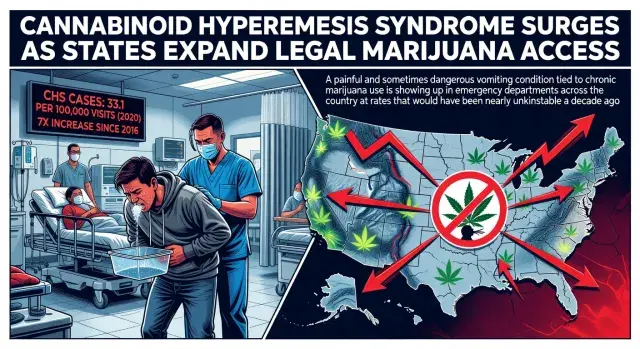
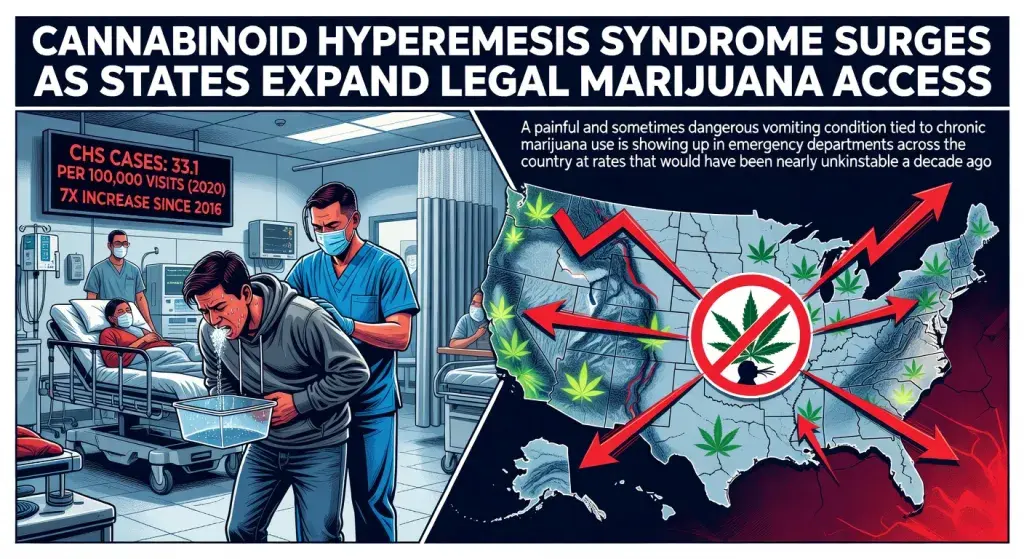
A painful and sometimes dangerous vomiting condition tied to chronic marijuana use is showing up in emergency departments across the country at rates that would have been nearly unthinkable a decade ago. Cannabinoid hyperemesis syndrome - CHS, in clinical shorthand - has gone from a medical curiosity first documented in Australia two decades ago to a condition that some hospitals now treat daily. The timing is hard to ignore: its rise tracks closely with the nationwide expansion of legal cannabis.
The Numbers Tell a Sharp Story
A 2025 study found that CHS diagnoses in emergency departments jumped from 4.4 per 100,000 visits in 2016 to 33.1 per 100,000 in 2020 - roughly a sevenfold increase in four years. The rate eased to 22.3 per 100,000 by 2022, but that still represents a dramatic baseline shift. Virginia alone has seen a nearly 29% rise in emergency visits for the condition since 2020. Massachusetts, Northern California, and parts of North Carolina have reported similar spikes. An official at Duke Regional Hospital in Durham said in June that CHS patients are seen "every week, if not every day."
And those are just the cases that make it to a diagnosis. Another study estimates more than 2.75 million Americans may be experiencing CHS symptoms - many of them likely unaware of what's causing their distress, or misdiagnosed with something else entirely, such as cyclic vomiting syndrome. The World Health Organization added CHS to its diagnostic manual only in October, a move that should make accurate identification easier going forward. Here's the catch: better diagnostic coding may itself account for part of the apparent surge, making it difficult to untangle rising awareness from rising incidence.
What CHS Actually Does to the Body
The syndrome unfolds in three phases. The first - prodromal - can last months or even years, marked by morning nausea and abdominal pain. Ironically, many patients increase their cannabis use during this stage, since marijuana is widely perceived as an anti-nausea remedy. Then comes the hyperemetic phase: severe, recurrent vomiting that can persist for hours. Some clinicians have adopted the blunt term "scromiting" - a portmanteau of screaming and vomiting - to describe what they witness.
Leonna Davis, a former patient who spoke to Nexstar's WIAT in 2021, described the experience starkly: "I would throw up 15 times in one, four-hour episode. I threw up for eight hours once, to the point that my throat was bleeding." She survived on popsicles and nutritional shakes. Dehydration and electrolyte imbalances during these episodes can cascade into seizures, kidney problems, and muscle spasms. People have died.
One oddity: patients almost universally report that scalding hot showers provide temporary relief. The mechanism isn't well understood, but the behavior is so consistent it's practically a diagnostic marker. Davis called them "scorching hot, boiling showers." Dr. Sam Wang, a pediatric emergency medicine specialist at Children's Hospital Colorado, recently told CNN the compulsion is "pretty universal."
The final phase - recovery - arrives only when the patient stops using cannabis entirely. All forms. No exceptions. Resuming use, even in small amounts, tends to trigger relapse.
Who's Most Vulnerable, and Why That's Complicated
A George Washington University study of over 1,000 people with CHS found that more than 40% reported using marijuana five or more times daily, and roughly the same proportion had used regularly for more than five years before symptoms appeared. Younger adults, ages 18 to 34, appear to face higher risk, as do Hispanic and Black individuals, according to Massachusetts-based research. A nationwide 2025 study found CHS was "notably more prevalent in the South," even though the heaviest cannabis use was concentrated in states with legal recreational markets - predominantly outside that region.
What remains genuinely puzzling is why some chronic users develop CHS and others don't. Dr. Chris Buresh, an emergency medicine specialist with UW Medicine and Seattle Children's, put it plainly: "It seems like there's a threshold when people can become vulnerable to this condition, and that threshold is different for everyone." Some patients report decades of trouble-free use before symptoms appear. Others get hit within a few years. Cedars Sinai has suggested the condition may involve brain receptors that stop responding to cannabinoids in the way they once did - but the honest answer is that nobody knows for certain.
Treatment Is Simple in Theory, Hard in Practice
Acute care typically involves IV fluids, antiemetics, pain management, and sometimes benzodiazepines. But these are stopgaps. The only known way to end episodes permanently is to quit cannabis - a recommendation that can be difficult for patients who have used the substance for years, often as self-medication for anxiety, chronic pain, or insomnia.
With the federal government appearing poised to reschedule marijuana following a December executive order from President Trump, access is likely to expand further. That makes public awareness all the more urgent. Davis's advice was direct: "If you smoke weed, please be informed." She urged anyone experiencing persistent morning sickness and finding relief only in hot showers to mention CHS to their doctor. "This could kill you," she said. Not alarmism. A clinical reality that emergency departments are confronting with increasing frequency.