Production at Fresh Venture Farms, a bell pepper propagator in Ontario, Canada, has risen an average of 16% over four years. Growers attribute the gain to advanced water treatment methods that enhance quality and cut costs. These techniques now support full water recycling and pathogen-free irrigation.
Cavitating Transmitters Drive Pathogen Control
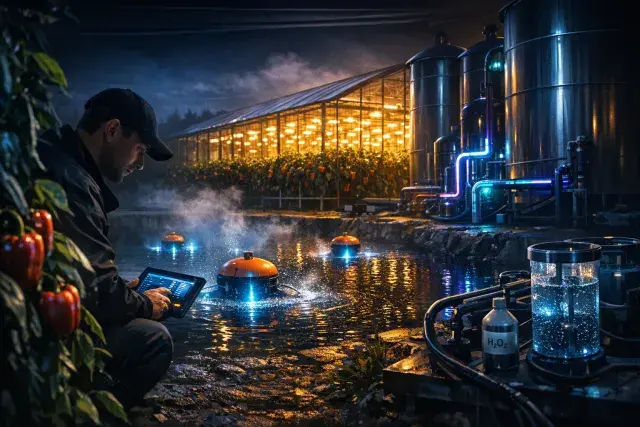
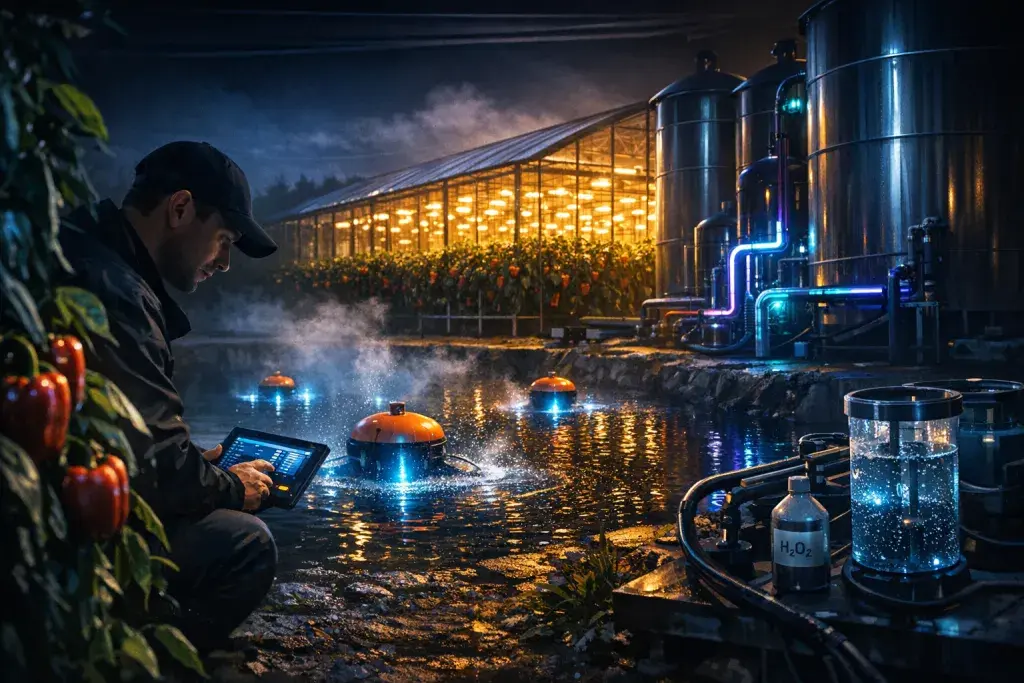
Fresh Venture Farms partnered with Ultramins over four years ago to deploy cavitating ultrasonic USAF™ DT-100 transmitters. Suspended under orange buoys in ponds and extended to silos and daily supply lines, the devices initially targeted the main water source. Florian Locher, a key figure at the farm, reports that two transmitters now serve silos while five handle daily irrigation, eliminating the need for other disinfection agents.
These transmitters generate cavitation and ultrasonic waves that disrupt pathogens like Fusarium and Pythium. DNA sequencing from A&L Laboratories confirmed high pathogen levels in untreated samples, proving the technology's effectiveness. Locher shares photos of vastly improved root systems, noting roots stayed healthy through the full growing season.
Nanobubbles and Hydrogen Peroxide Cut Costs
Last year, the farm added nanobubble technology alongside regular 35% hydrogen peroxide dosing in the daily supply. Hydrogen peroxide use dropped more than 50%, saving $0.10 to $0.15 per square meter annually. This shift eliminated synthetic agents entirely, slashing costs per square meter by 40% to 50%.
The return on investment came in under six months, far quicker than typical for farm upgrades. By 2025, production should reach over 35 kilograms per square meter. Locher calls the approach a "no-brainer," as it enables 100% water recycling with confidence in its cleanliness.
Implications for Sustainable Greenhouse Farming
Clean irrigation water underpins high-density greenhouse operations, where pathogens spread rapidly through recirculated systems. Traditional chemical reliance raises costs and environmental concerns, but physical methods like cavitation and nanobubbles offer precise control without residues. Fresh Venture Farms demonstrates how such integrations streamline operations and boost yields.
For other propagators facing water quality challenges, this model highlights scalable alternatives. Full pathogen elimination supports denser planting and longer crop cycles, aligning with pressures to reduce inputs amid climate variability and resource limits. The farm's results point to broader adoption in controlled-environment agriculture.