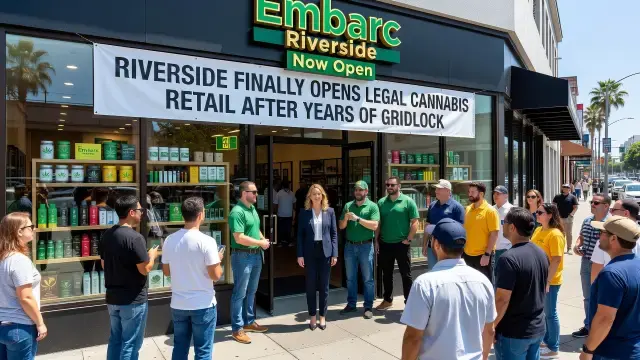
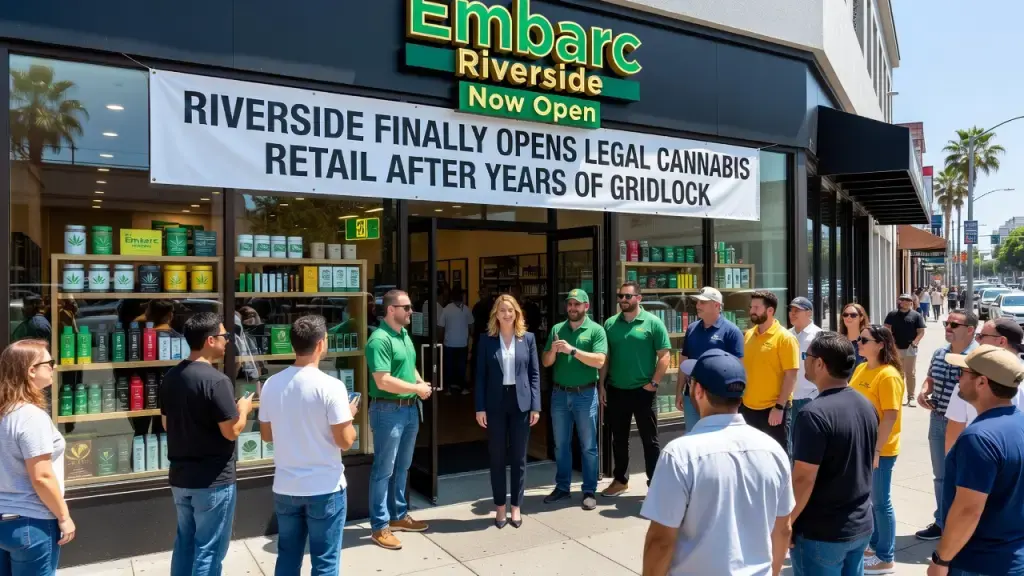
Riverside's first licensed dispensary has opened its doors, closing out a regulatory saga that outlasted most of the businesses now entering the city's cannabis market. Embarc's Magnolia Avenue store went live in March, nearly a decade after California voters approved adult-use legalization statewide. For an industry that measures delay in carrying costs and lease payments, Riverside's timeline is a case study in how local politics can outpace state law by years.
A Moratorium That Outlived Its Usefulness
Riverside spent years under a commercial cannabis moratorium before the City Council voted 5-2 in February 2023 to allow retail sales. That vote didn't open the floodgates, though. Location restrictions and permit allocation disputes kept the program in limbo well past the initial approval - the kind of gap between policy and implementation that operators in this industry have learned to expect and budget around. A yes vote is not a storefront. Build-out, local permitting, state licensing through the Department of Cannabis Control, and site-specific zoning review all still have to clear before a single transaction happens at the register.
The city's original framework allowed for up to 14 dispensaries citywide. That number got trimmed considerably when the Council voted 4-1 in July 2025 to cap retail licenses at one per ward. Councilmember Sean Mill, who represents Ward 5, framed the delay bluntly: voters had already said what they wanted, and the can had been kicked for years. Fair enough - but the ward-based cap also reshapes the competitive map for every operator still waiting on a permit decision, since geography now functions as a de facto scarcity mechanism.
What the Application Fight Reveals About Local Licensing
Riverside released its request for proposals in November 2023; Embarc submitted that December. The city then worked through a competitive applicant pool, with Embarc and STIIIZY ultimately tying and both moving forward. That outcome matters for how other California cities structure cannabis RFPs: merit-based scoring systems can produce ties, and municipalities need tie-breaking procedures built in before applications land, not after.
Embarc's founder and CEO, Lauren Carpenter, described the process as thorough and time-intensive, with moments where a Riverside location felt genuinely uncertain. That's a familiar pattern for operators navigating local cannabis licensing in California, where state approval is only half the equation and municipal control over zoning, buffer zones, and permit caps can stall or kill a project that already cleared state-level hurdles.
Community Engagement as a Compliance Strategy
Carpenter pointed to a local listening tour conducted before the application was even submitted - a step aimed at surfacing community concerns about cannabis retail before they turned into council opposition. In cities that fought legalization at the ballot box or through years of moratoriums, that kind of groundwork isn't optional polish. It's risk mitigation. Operators who skip community outreach tend to run into the same zoning objections and public comment pushback that stalled Riverside's program in the first place.
Carpenter also noted that members of her team worked on Proposition 64, the 2016 ballot measure that legalized adult-use cannabis in California. Opening in a city that took this long to implement that law is, as she put it, a full-circle moment for people who worked the policy side years earlier.
What Comes Next for Riverside's Retail Map
Embarc has a second Riverside location planned for University Avenue, and under the ward-based cap, additional operators will fill out the remaining districts over time. For landlords, wholesalers, and ancillary vendors watching Riverside, the lesson is less about any single storefront and more about sequencing: license caps, zoning disputes, and city council turnover can stretch a market opening from months into years, and the operators who survive that stretch are usually the ones who treated local compliance and community relations as core business functions rather than paperwork.