
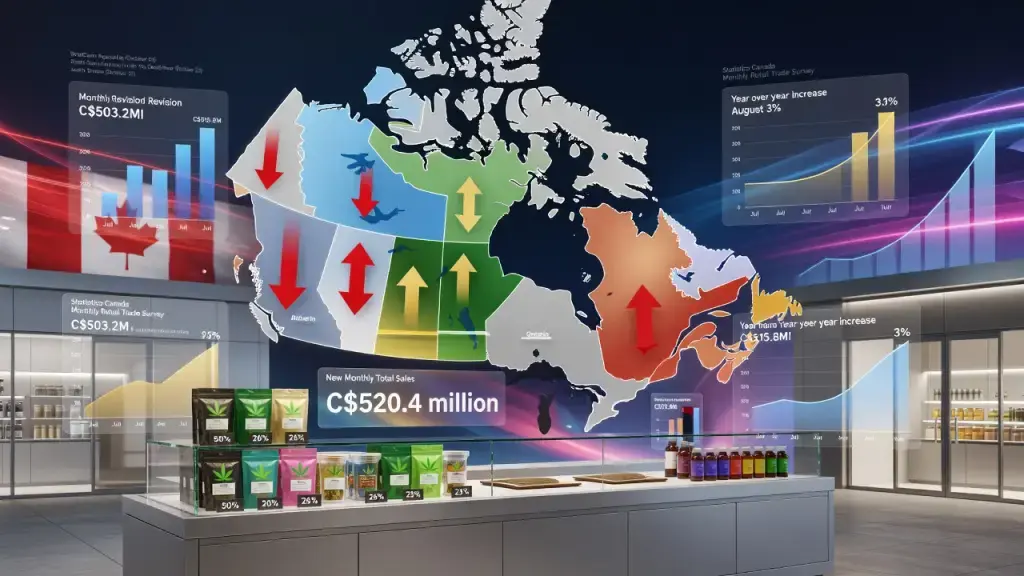
Canada's legal cannabis retailers posted C$520.4 million in sales for August, a new monthly high, according to David Brown's October 23 reporting for StratCann. The figure looks like unambiguous good news for an industry that has spent years fighting thin margins and oversupply. It is, but only if you read it carefully - and the fine print here matters more than the headline number.
A record built on a moving baseline
StratCann's reporting puts the preliminary August total about 3% above the same month last year. That's a reasonable year-over-year gain, not a blowout. Here's the catch: July's figure was revised upward during this same release, from C$503.2 million to C$515.8 million. Use the old July number and August looks like a dramatic jump. Use the revised one, and the monthly increase shrinks considerably. This is standard practice for Statistics Canada's Monthly Retail Trade Survey, which accepts estimates from retailers when final data aren't available at collection time and revises them as better information comes in. For anyone tracking wholesale pricing or planning inventory against sell-through trends, the lesson is blunt: never compare a new month against an old vintage of the prior month. Pull both figures from the same current release, or the comparison is built on sand.
One national number, several different markets
The provincial breakdown tells a more complicated story than the topline suggests. Brown's reporting notes that Alberta's sales actually declined year over year, while Manitoba logged the strongest percentage gain of any province. Ontario - still the largest cannabis retail market in the country by a wide margin - grew by less than 1%. That's practically flat for the province that moves the most product through legal storefronts. For multi-province operators and wholesale brands building distribution plans, this matters a great deal. A national record says nothing about whether a given dispensary's foot traffic, budroom turnover or POS terminal receipts are actually improving. Store-level performance, local competition from unlicensed sellers, and provincial pricing dynamics all diverge sharply from the aggregate. Treat the national figure as a starting point for questions, not a substitute for regional due diligence.
Dollars sold are not units moved
A second complication: Statistics Canada's retail-dollar figures and Health Canada's cannabis market data measure entirely different things, and operators conflate them at their own risk. Health Canada's most recent published product breakdown covers June 2026 - two months before the retail record in question - and reports dried flower at 50% of combined medical and non-medical unit sales, with edibles at 26% and extracts at 23%. Those are unit shares, not revenue shares. A single-gram flower package and a multi-pack edible both count as one unit despite wildly different price points and margins. Health Canada itself cautions that this data is revised as validation continues and generally isn't estimated for unsubmitted reports except in rare cases. Pairing a dollar-based retail survey with a unit-based product series, without acknowledging the different reference periods and methodologies, produces analysis that sounds precise but isn't.
What this means for operators and suppliers
The practical takeaway for compliance teams, finance staff and category managers is a simple reading discipline, not a reason for alarm or celebration. Before acting on any cannabis sales headline:
- Note the currency, the reference month, and the release date - they are rarely the same month
- Confirm whether the figure measures retail dollars or product units
- Check whether the comparison period has been revised since its original release
- Separate national aggregates from provincial or store-level performance before drawing conclusions
None of this diminishes the fact that legal retail spending hit a new high in August. It does mean that a single monthly total, however large, can't tell wholesalers whether to adjust production runs, tell landlords whether retail rents in a given province are sustainable, or tell a dispensary operator whether their own numbers are keeping pace. The real signal will come from whether August's gain holds up after the next round of revisions, and whether growth broadens beyond Manitoba's outperformance to markets like Alberta and Ontario, where the picture right now is flat or worse.