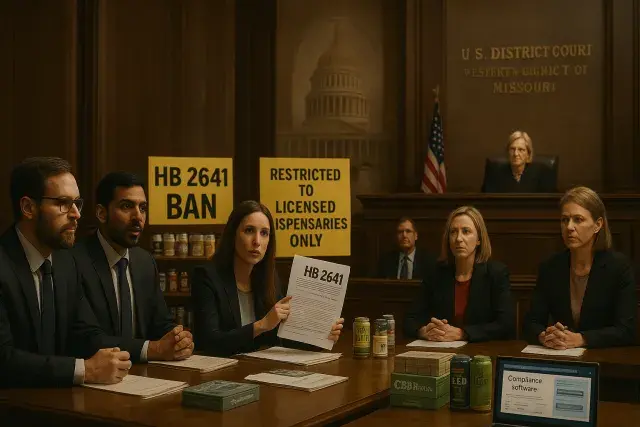
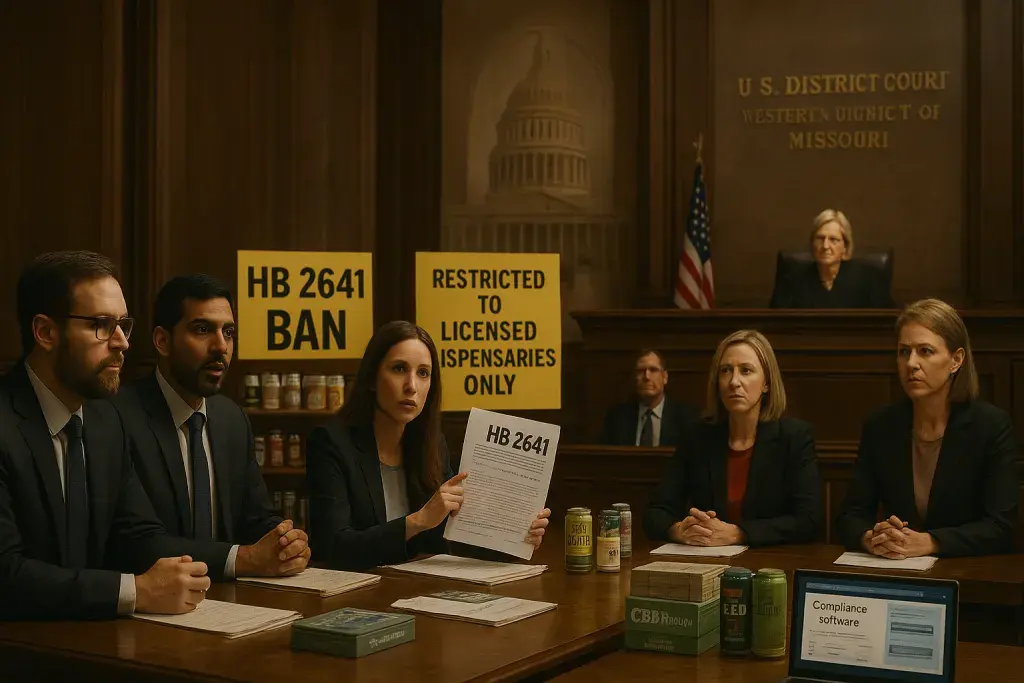
A coalition of Missouri-based and multistate hemp businesses filed a federal lawsuit Thursday challenging a new state law that would pull all intoxicating hemp products from general retail shelves starting November 12. Filed in the U.S. District Court for the Western District of Missouri, the suit claims the legislation-House Bill 2641, signed earlier this year by Gov. Mike Kehoe-contains definitions so internally contradictory that they render the law unconstitutionally vague. The stakes are immediate: retailers statewide are stocking these products today, and the clock on compliance is running.
The plaintiffs include MNG 2005, Inc., the St. Louis-based parent company of 55 CBD Kratom stores nationwide; the Missouri Hemp Trade Association; and Wisconsin-based Lifted Liquids Inc. Their core argument is that HB2641 simultaneously classifies the same products as both "hemp" and "marijuana" in different sections-a drafting problem that leaves everyone from store managers to prosecutors without a clear line to enforce or comply with. That kind of definitional ambiguity is exactly the sort of problem that compliance professionals in licensed cannabis markets deal with constantly. In regulated adult-use states, operators rely on tightly maintained seed-to-sale tracking systems-similar in principle to what powers Maryland seed-to-sale dispensary software-to ensure every product's classification, THC content, and legal status is documented and defensible. When the underlying statute is contradictory, no software or compliance protocol can bridge that gap.
Craig Katz, government relations and compliance manager at MNG, put the problem plainly: lawmakers don't fully understand what they're regulating, and the resulting language reflects it. That isn't an unusual observation in cannabis policy circles. Across states, legislators have repeatedly passed cannabis rules that conflict with existing hemp definitions inherited from the 2018 federal Farm Bill-creating gray zones that businesses, law enforcement, and courts have struggled to interpret. Missouri's bill goes a step further by also restricting who may transport hemp products through the state, which the coalition argues crosses into federal interstate commerce protections.
What the Law Actually Does-and Why It Matters for Retail
HB2641 is broad. It removes intoxicating hemp products-including THC-infused seltzers currently sold in bars and grocery stores-from general retail entirely. If those products return to market at all, they would only be sold through Missouri's licensed marijuana dispensaries. That's a significant channel shift. Right now, hemp-derived intoxicating products occupy a separate retail lane entirely: smoke shops, convenience stores, grocery shelves-spaces with none of the compliance infrastructure that licensed dispensaries maintain. Moving them into the dispensary channel means age verification protocols, state-mandated product testing, compliant packaging, point-of-sale system integrations, and inventory tracking requirements would all apply.
For Missouri's licensed dispensary operators, that could look like an expansion of their addressable product market. But the coalition frames it differently-as a government-mandated monopoly. "This isn't consumer protection," said Jay Patel, president of the Missouri Hemp Trade Association. "It's the elimination of an entire legal industry coupled with a government-mandated monopoly." The business implication cuts both ways: dispensary operators might eventually gain shelf space for products they can't currently carry, while hemp retailers face an existential compliance problem with no clear path to licensure or market continuation.
The Vagueness Argument and Its Criminal Consequences
The constitutional core of the lawsuit is the vagueness claim. Because unlicensed marijuana activity is a criminal offense in Missouri-not a civil one-the coalition argues that businesses cannot know whether they are operating legally or exposing themselves to prosecution. That's a meaningful distinction. A compliance gray zone in alcohol distribution or food retail might carry regulatory fines. In cannabis, the same ambiguity can carry criminal consequences for owners, managers, and employees.
The coalition also raises a specific concern: the law's effective date provisions are, in their words, "so convoluted that businesses cannot determine which products are covered or when." For any retailer managing SKU-level inventory decisions, that's an operational problem before it's even a legal one. When do products have to come off shelves? Which SKUs are covered? Does a non-intoxicating CBD tincture with trace THC fall under the ban? The coalition believes it might-meaning the law's reach could extend well beyond intoxicating products into the broader hemp supplement market.
The Broader Regulatory Context
Missouri's bill is not isolated. It largely mirrors a federal ban that Congress approved last year, and Rep. Dave Hinman, the bill's sponsor, has said the legislation gives state law enforcement the authority to enforce that federal ban at the state level. What's striking here is the synchronization between state and federal timelines-and what happens if they fall out of step. Under HB2641, if Congress reverses course and permits these products federally, Missouri would still restrict them to licensed dispensaries. If Congress delays the federal ban, Missouri would prohibit all intoxicating hemp products anyway-except for intoxicating beverages, which would remain a carveout.
That conditional structure creates layered compliance uncertainty for any multistate hemp operator trying to build a coherent product and distribution strategy. The law's outcome depends not just on Missouri courts, but on federal legislative timing that nobody can accurately predict. Hinman has signaled he expects the lawsuit to fail, calling it a last-ditch effort that won't override legislation that passed both chambers and received the governor's signature. The defendants-Kehoe, Attorney General Catherine Hanaway, and DHSS Director Sarah Wilson-have declined to comment on pending litigation, and Hanaway's office confirmed it had not yet been served.
The November 12 effective date is close. If the coalition doesn't secure a preliminary injunction quickly, the products come off the shelves regardless of how the broader case proceeds. That's the immediate pressure every hemp retailer in Missouri is watching right now.