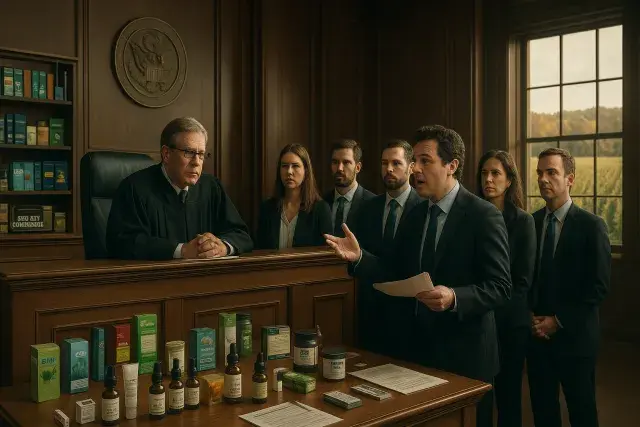

One clause, copied from a decades-old research paper into the 2018 farm bill, quietly legalized a national market in intoxicating hemp products. Now that same clause is scheduled to expire on November 12, 2026, replaced by a federal THC limit so low it would eliminate the low-dose beverages and full-spectrum CBD products that built a multibillion-dollar retail category. For dispensary operators, hemp beverage brands, alcohol distributors, and the compliance teams sitting between them, the countdown has already reshaped purchasing decisions, shelf placement, and state-level lobbying strategy.
The mechanics matter here, because this was never a story about cannabis legalization in the traditional sense. The 0.3% delta-9 THC threshold measured hemp by dry weight, a formula that made sense for fiber and grain but left a mathematical opening for liquid products once emulsion technology caught up. That gap let hemp-derived THC beverages and gummies flow into liquor stores, gas stations, and grocery chains in states where adult-use cannabis remained illegal - no dispensary license required, no METRC seed-to-sale tracking, no state excise tax structure built to handle it. Operators who did hold cannabis licenses watched a parallel, largely unregulated market emerge next door, governed by agricultural law rather than cannabis compliance regimes. Retail infrastructure had to catch up fast; many independent stores adopted the same kind of dispensary software in Oregon and other adult-use markets to manage inventory, batch tracking, and age verification for both cannabis and hemp-derived product lines, even though the two categories answered to entirely different regulators. dispensary software in Oregon
That regulatory split is exactly what has come under attack. Senator Mitch McConnell's push to close what his office calls a "bad-actor loophole" would replace the dry-weight ratio with a hard cap of 0.4 milligrams of THC per container - a number too small to produce a low-dose seltzer or a full-spectrum CBD tincture with any meaningful effect. The stated target is high-potency synthetic cannabinoid products, sometimes marketed as candy and sold with no age-gating at convenience counters. But the fix, as written, does not distinguish between those products and a 3-milligram beverage sold through a licensed distributor with lab-tested batches and compliant packaging. That's the part hemp beverage companies find maddening: the bad actors and the compliant operators are being regulated with the same blunt instrument.
What Compliant Operators Actually Stand to Lose
For hemp beverage producers and the retailers stocking them, the practical stakes go beyond a single SKU. Distribution deals with regional beverage wholesalers, cold-chain logistics built around perishable canned products, and retail placement negotiated with grocery and convenience chains all assume a legal THC ceiling that allows a dosed product to exist. Drop that ceiling to 0.4 milligrams and the entire wholesale menu for low-dose drinks disappears overnight, regardless of how clean a company's lab testing and COA documentation look. Farmers growing hemp for CBD and beverage-grade extract face the same cliff on the cultivation side, with no clear signal on what, if anything, replaces the crop's current market.
The Alcohol Industry's Quiet Hand in the Rulemaking
Alcohol producers have not been shy about their interest in how this shakes out. Facing a genuine competitor in hangover-free, lower-calorie THC drinks, industry groups have pushed both for the federal potency cap and for state-level rules folding hemp beverages into three-tier alcohol distribution systems - the same producer-wholesaler-retailer structure that governs beer and spirits. That would mean new licensing requirements, new tax treatment, and new compliance obligations for a product category that grew up largely outside that framework. Whether that outcome protects consumers or simply protects market share is the question hemp advocates keep asking, without much of an answer yet from Washington.
Where This Leaves Retailers and Regulators
Dispensary owners in adult-use states have their own reason to watch this fight closely. A federal potency cap that guts the hemp beverage market could push some of that consumer demand toward licensed cannabis retail, where THC beverages are already sold under state testing and packaging rules. That's not necessarily a bad outcome for operators sitting on 280E tax burdens and thin margins, but it does mean point-of-sale systems, inventory forecasting, and staff training need to account for a possible shift in what walks through the door. The larger lesson, regardless of how November 2026 resolves, is that a single definitional clause in unrelated legislation can build - or dismantle - an entire retail category with almost no public debate at the time it's written.