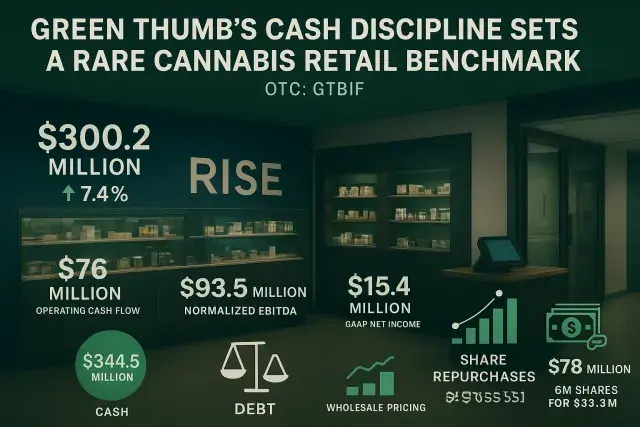

Green Thumb Industries opened two dispensaries in Florida this October - RISE Dispensary Cape Coral and RISE Dispensary Belleview - pushing its state count to 26 stores and its national footprint past 120 locations. The additions are modest on paper, but they land at a moment when investors are parsing whether multi-state operators can still convert store growth into durable cash flow, or whether price compression and operating costs have become the dominant force in the sector.
What the Belleview and Cape Coral Stores Actually Do
The Belleview opening, which took place October 16, matters more than its size suggests. It sits inside Marion County and ties directly into Green Thumb's Ocala cultivation and production facility. That's a seed-to-sale arrangement in practice, not just in compliance paperwork: product grown and processed at Ocala moves into a retail shelf a short drive away, cutting transport friction and giving the company tighter control over batch availability and SKU management. Cape Coral extends that same logic into Lee County, widening access across a medical market where patient counts and purchasing patterns vary meaningfully by region. For a vertically integrated operator, this kind of geographic layering is the whole point - cultivation capacity only pays off if retail doors are positioned to move the inventory it produces.
The Investment Case Hasn't Fundamentally Moved
Here's the catch with reading too much into two store openings: the broader thesis for owning Green Thumb was never about store count alone. It rests on whether a national network of over 120 dispensaries can keep producing cash despite a sector that has been grinding through price compression for years. Florida, Minnesota, and emerging adult-use markets like Virginia are the pieces analysts point to when building a growth case - each one offering incremental revenue without requiring the company to bet the business on a single state's regulatory timeline. Florida's medical program, with its structured testing and labeling requirements, continues to be a stable contributor. But stable isn't the same as accelerating.
Current analyst modeling has Green Thumb reaching roughly $1.5 billion in revenue by 2029 on about 6.6% annual growth, yet earnings are projected to fall to $79.6 million from today's $126.8 million - a decline, not an improvement, of around $47 million. That's a notable disconnect: top-line growth paired with shrinking profitability. The explanation usually offered is rising SG&A and continued wholesale pricing pressure eating into margins faster than new stores can offset them.
Where the Real Risk Sits
The more bearish analyst scenarios assume even less room to maneuver - revenue near $1.4 billion and earnings around $49.1 million by 2029, built on the premise that near-term revenue stays flat while SG&A keeps climbing. Whether Florida expansion shifts that outlook depends on execution details that don't show up in a press release: same-store sales trends, inventory shrinkage control, and whether the Ocala-to-Belleview supply chain actually lowers per-unit costs or just adds another compliance log to track.
Federal rescheduling remains the swing factor nobody can fully price in yet. A shift away from the current 280E tax treatment would materially change cash flow for any multi-state operator carrying Green Thumb's footprint, Florida stores included. Until that moves, though, the operational grind - pricing discipline, cost control, and steady execution across two dozen Florida dispensaries - is what will determine whether this expansion supports the growth case or simply adds square footage to a thesis still waiting on catalysts outside the company's control.