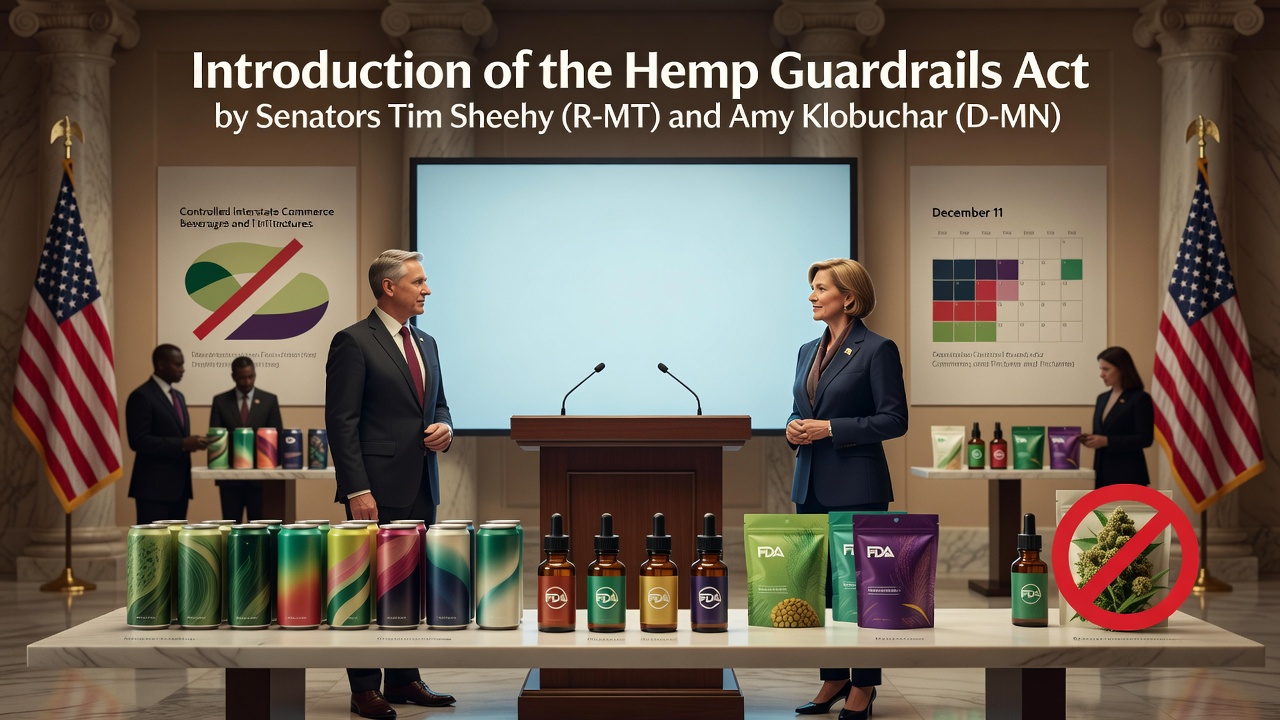
A federal recriminalization date is three weeks away, and a bipartisan Senate bill just gave the hemp industry its clearest off-ramp yet. Sens. Tim Sheehy (R-MT) and Amy Klobuchar (D-MN) introduced the Hemp Guardrails Act this week, proposing a regulatory framework to replace the blanket ban on hemp-derived THC products currently set to take effect December 11. For dispensary operators, beverage brands, wholesalers and the retailers who stock their shelves, the bill represents the most detailed legislative alternative to prohibition introduced so far.
What The Bill Actually Changes
The mechanics matter here, and they're more technical than a simple extension. The legislation would raise the legal THC threshold to one percent total THC on a dry-weight basis, with an allowance for in-process materials to exceed that during manufacturing. At the same time, it creates a new prohibited category covering delta-8 THC, delta-10 THC and THC-O-acetate, and it would restrict synthesizing those compounds outside the hemp plant entirely. Conversion processes for CBD and delta-9 THC would still be allowed, but only when the resulting product occurs naturally - a distinction that will matter enormously to contract manufacturers running conversion lines.
Smokable hemp flower, raw floral material and pre-rolls would be barred from interstate commerce outright. That's a direct hit to a segment of the market that has operated in a gray zone since the 2018 Farm Bill, and it signals where this Congress wants the industry to land: beverages, tinctures and packaged goods, not flower that mimics state-licensed cannabis products.
Compliance Load Shifts To FDA And Manufacturers
The bill directs the FDA to issue rules on packaging, labeling, manufacturing, testing, registration and recalls within 180 days - a mandate the agency is already behind on. The Congressional Research Service recently flagged that FDA is more than nine months late delivering a required list of known cannabinoids and container guidance from last year's hemp law. Another deadline on top of a missed one is not a small operational detail for brands trying to plan product reformulations.
Age verification would be set at 21 for possession and consumption, and products would need to be grown, processed and packaged domestically to qualify as legal. States would keep authority to impose stricter rules locally, but they couldn't block interstate transport of compliant goods - a provision aimed at preventing the kind of patchwork that has already made multistate hemp beverage distribution a compliance headache.
- One percent total THC dry-weight threshold, with in-process exceptions
- Delta-8, delta-10 and THC-O-acetate classified as prohibited synthetic cannabinoids
- Smokable flower and pre-rolls excluded from interstate commerce
- 21-and-over age limit for possession and purchase
- Domestic grow-process-package requirement
- FDA rulemaking deadline of 180 days for labeling, testing and recall standards
Why This Is Landing Now
Last year's funding legislation redefined hemp so that only products with 0.4 milligrams of total THC per container would remain legal after November 12 - effectively criminalizing most of the hemp beverage and edible category overnight. A September funding bill pushed the deadline for most products to December 11, though synthetic cannabinoids not naturally producible by the cannabis plant lost their legal status on the earlier date. That timeline has put retailers, distributors and beverage brands in a holding pattern, unsure whether to keep ordering inventory or start pulling SKUs off shelves.
The Sheehy-Klobuchar bill isn't the only vehicle in motion. Rep. James Comer (R-KY) is circulating similar language and has said attaching it to a continuing resolution is the most realistic path to passage, since that's "the only bill that absolutely, positively has to pass." Reps. Beth Van Duyne and Greg Landsman have proposed taxing and regulating hemp THC drinks like alcohol, while Rep. Andy Barr and the Griffith-Veasey pairing have filed their own regulatory frameworks. Jonathan Miller of the U.S. Hemp Roundtable said the industry is unified behind the Senate bill and is now working to get its provisions folded into whatever spending package moves next.
What Operators Should Watch
For retailers carrying hemp-derived beverages or tinctures, the practical question is less about ideology and more about inventory risk. A wholesale menu built around products that could become federally illegal in a matter of weeks is not a stable position, and compliance logs will need to track whatever threshold eventually becomes law - whether that's the current 0.3 percent delta-9 standard, the proposed one percent total THC figure, or something negotiated in conference. Payment processors and point-of-sale vendors serving hemp retailers will also need to watch how "prohibited cannabinoid" categories get defined, since SKU-level compliance flags depend on clear federal language, not shifting deadlines attached to continuing resolutions.
Nothing here is settled. The bill is a proposal, not law, and the clock on the current ban keeps running regardless of how many competing frameworks circulate on Capitol Hill.