
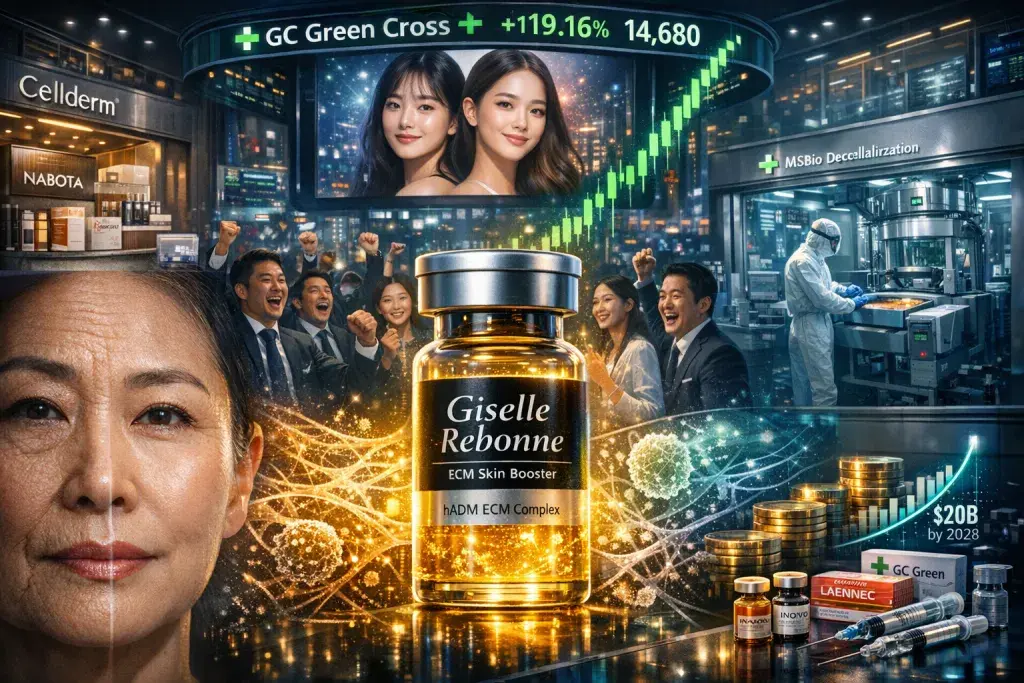
On July 25, shares of GC Green Cross Wellbeing (234690.KQ) rocketed 19.16% to close at 14,680 won, fueled by the company's announcement of launching "Giselle Rebonne," a cutting-edge human tissue-based extracellular matrix (ECM) skin booster. This surge underscores the booming demand for regenerative aesthetics in South Korea's competitive med-spa market.
Breakdown of the Product Innovation
Giselle Rebonne represents a leap in skin rejuvenation technology, utilizing human acellular dermal matrix (hADM) derived from processed human tissue. Unlike traditional skin boosters that merely stimulate collagen indirectly, this ECM product delivers the actual extracellular matrix structure, enabling direct tissue remodeling and foundational skin regeneration.
- Developed with MS Bio's proprietary decellularization process to eliminate cells and immune triggers.
- Processed at GC Green Cross Wellbeing's Eumseong tissue bank for stringent raw material control.
- Offers superior biocompatibility, slashing risks of rejection, inflammation, or adverse reactions.
Experts in regenerative dermatology hail this as a "next-generation" booster, aligning with global shifts toward biomimetic therapies that mimic the body's natural scaffolds for lasting anti-aging effects.
Strategic Portfolio Expansion
This launch bolsters GC Green Cross Wellbeing's aesthetic lineup, now encompassing placenta injections like "Laennec," dermal fillers, skin boosters, and botulinum toxin "Innovo." It mirrors aggressive moves by rivals: Hugel partners with Hans Biomed on "Cellrderm," while CG Bio eyes bundled sales with Daewoong's "Nabota" and "V-Olet."
The strategy taps into South Korea's dominance in aesthetic medicine, where per capita procedures rival the U.S., driven by K-beauty culture and rising wellness spending among millennials and Gen Z seeking preventive, natural-looking enhancements.
Market Implications and Broader Trends
The stock jump signals investor confidence in ECM's disruptive potential amid a global aesthetics market projected to exceed $20 billion by 2028. Causes include heightened consumer preference for tissue-engineered products over synthetics, backed by clinical evidence of faster recovery and superior outcomes in wrinkle reduction and elasticity.
Yet, implications extend to ethical sourcing and regulation: rigorous tissue banking ensures safety, but scaling human-derived tech demands oversight to prevent shortages or quality dips. As regenerative skincare permeates lifestyle trends—from celebrity endorsements to at-home regimens—GC Green Cross Wellbeing positions itself as a leader in sustainable beauty innovation.