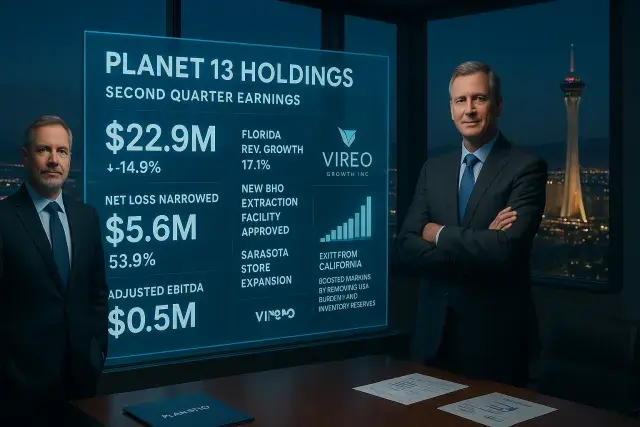
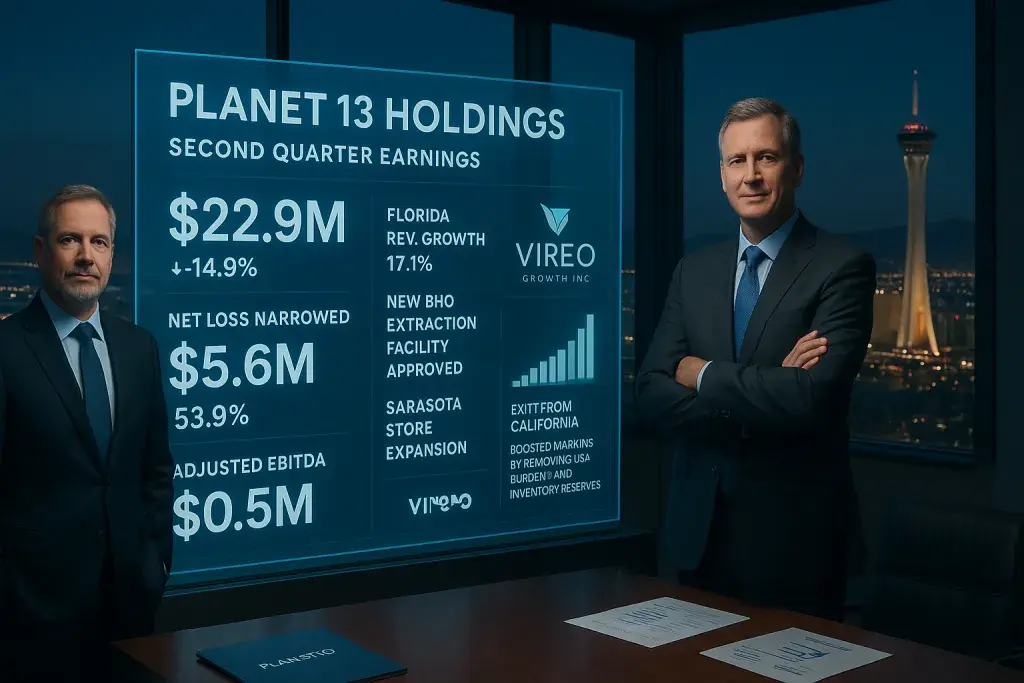
Planet 13 Holdings reported second-quarter revenue of $22.9 million, down 14.9% from a year earlier, but the multi-state operator narrowed its net loss to $5.6 million and improved gross margin to 53.9% as it works through a pending merger with Vireo Growth Inc. The results, announced August 12, cover the quarter ended June 30, 2026, and mark the last standalone earnings report before the two companies expect to close their combination.
Margin Gains Mask a Shrinking Top Line
Here's the tension at the center of this report: revenue fell nearly 15%, yet nearly every other operating metric improved. That's not a contradiction so much as a deliberate trade-off. Planet 13 exited California retail and wholesale operations entirely, a market that had been dragging on margins for multi-state operators generally, given the state's brutal wholesale pricing and heavy tax burden layered on top of federal 280E exposure. Pulling out of California trims the top line but removes a persistent drag on profitability, and the numbers back that up: gross margin rose from 43.4% to 53.9% year over year, helped in part by a $1.0 million reduction in the company's inventory reserve for Florida distillate. Strip out that one-time reserve adjustment and margin still landed at 49.5%, a meaningful improvement driven by company-wide procurement and cost initiatives rather than accounting noise alone.
Total expenses fell 17.7% to $15.2 million, and Adjusted EBITDA loss narrowed to $0.5 million from $2.4 million a year prior. For a sector where cash discipline often determines who survives to the next licensing cycle, that kind of expense reduction matters more than the headline revenue figure.
Florida Momentum Offsets Nevada Price Compression
Florida revenue grew 17.1% quarter over quarter, a notable reversal for a market Planet 13 has been working to stabilize. Co-CEO Larry Scheffler pointed to that Florida growth as evidence the company's operational fixes are taking hold. In May, the company received Office of Medical Marijuana Use approval for a Florida BHO extraction facility, adding in-house butane hash oil production capacity that should reduce reliance on third-party processors and give the company tighter control over batch consistency and testing timelines. A Sarasota store expansion announced in July extends the retail footprint further into a state where medical cannabis demand continues to outpace some of the more mature adult-use markets.
Nevada remains a harder story. Continued price compression there, a familiar pattern in states with dense license concentration around tourist corridors, keeps squeezing wholesale menus even for an operator with Planet 13's scale advantage in Las Vegas. Illinois, where the company opened its Waukegan dispensary serving the Chicago metro area, adds geographic diversification but hasn't been broken out in enough detail here to draw firm conclusions about its contribution.
What the Vireo Merger Means for Stakeholders
The July 27 announcement of a definitive merger agreement with Vireo Growth reframes how this quarter should be read. Co-CEO Bob Groesbeck was direct about the rationale: the market increasingly rewards scale, purchasing power, and balance-sheet strength to absorb ongoing price compression. That's a candid admission from a company that spent years building a vertically integrated brand around flagship retail experiences. Combining with Vireo is a bet that a larger, more efficient entity can better withstand wholesale pricing pressure and 280E's tax drag than Planet 13 could alone.
Because of the pending deal, Planet 13 skipped its usual quarterly conference call, a signal that management is keeping public commentary tightly controlled during the transaction. For dispensary operators and investors watching consolidation activity across state-legal markets, this deal is worth tracking as a template: shrinking margins in saturated markets like Nevada and California are pushing even established brands toward combination rather than standalone growth. Balance sheet figures show total assets slipping to $144.3 million from $152.3 million at year-end 2025, while liabilities rose to $105.5 million, underscoring why scale and cash access matter heading into the closing process.