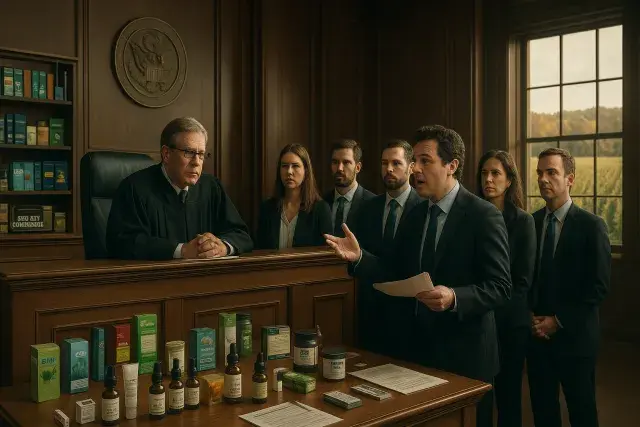
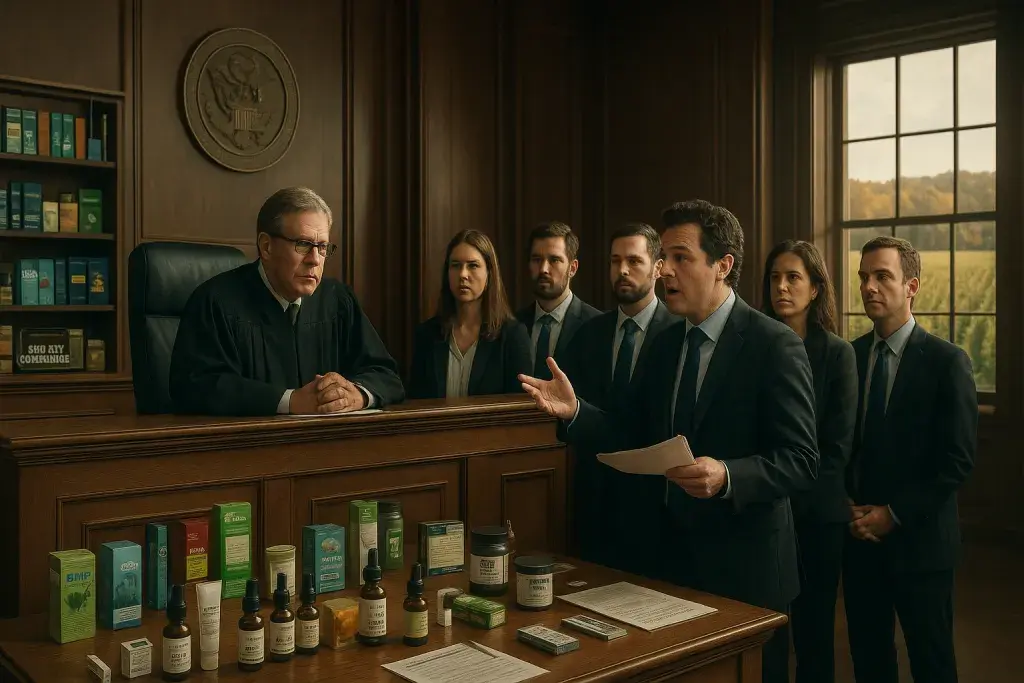
A federal judge in Virginia spent nearly five hours Wednesday weighing whether to pause a new state law that would sharply tighten limits on hemp-derived products before it takes effect Saturday. Seven hemp businesses asked U.S. District Judge Robert S. Ballou for a temporary injunction, arguing the restrictions would strip legal status from inventory already sitting on shelves. No ruling came from the bench, but the businesses' attorney, Chap Petersen, said he expects a decision within days.
The dispute centers on House Bill 30, which was folded into Virginia's budget and eliminates the state's longstanding 25-to-1 CBD-to-THC exception. In its place: a flat two-milligram total-THC-per-package cap for most hemp products sold at retail. That's a dramatic tightening for an industry that built its wholesale menus, its lab testing protocols, and its store operations around the old ratio. For dispensary-adjacent hemp retailers, this isn't a paperwork tweak - it's a compliance cliff. Operators who invested in point-of-sale infrastructure, inventory management, and even regional systems like cannabis pos systems ontario retailers use to track SKU-level compliance know how disruptive a sudden shift in product definitions can be to daily retail operations.
What makes this case notable beyond Virginia is the mechanism: a THC threshold change enacted through a budget bill rather than standalone cannabis legislation, with roughly six weeks between the governor's signature and enforcement. Petersen argued that timeline made compliance nearly impossible, especially for an agricultural supply chain. Hemp crops planted in April, he noted, are harvested in October and have no alternate market once processed - unlike a piece of equipment that can simply be trucked across a state line.
What the Two-Milligram Cap Actually Changes
Under the prior framework, a product could carry meaningful CBD content as long as THC stayed below a 25-to-1 ratio - a structure that let manufacturers formulate tinctures, edibles, and topicals with some flexibility. The new rule scraps that ratio test entirely and replaces it with a hard per-package ceiling. In practice, that reclassifies a wide swath of existing SKUs as non-compliant hemp, meaning they'd fall outside the legal definition altogether rather than simply needing new labeling or lab retesting. For retailers, that's the difference between a relabeling cost and a total inventory write-off.
The Compliance Whiplash Problem
Business owners testified that products legal at midnight could become unsellable hours later, with no wind-down period, no buyback mechanism, and no clarity from the state's cannabis regulatory agency on how enforcement would work. Petersen said the agency issued no guidance documents, no town halls, nothing operators could use to plan disposal, returns, or reformulation. That silence matters: compliant packaging changes, COA updates, and SKU discontinuation all take lead time most operators didn't get.
Why the Injunction Fight Matters Beyond Virginia
The plaintiffs aren't asking the court to strike the law outright - yet. They want breathing room to sell existing inventory while pursuing a broader constitutional claim, including a potential takings argument tied to the value destroyed in businesses built under the old rules. If Ballou denies the injunction, the restrictions take effect Saturday and could push a meaningful share of Virginia's hemp retail and manufacturing base out of compliance almost overnight - a preview of the regulatory risk other states face as they narrow the line between hemp and adult-use cannabis.